Written by: Ellie Pranckevicius, FNP-BC, Aesthetic Nurse Practitioner & Aesthetic Injector | Facial Restoration & Regenerative Injectable Specialist, Mirror Plastic Surgery
Key Takeaways for Safe GLP-1 Storage
- Most GLP-1 medications stay in the refrigerator at 36–46°F (2–8°C) before first use, then follow brand-specific room-temperature windows once opened.
- Unopened pens remain stable until their printed expiration date under continuous refrigeration, while compounded vials follow pharmacy-assigned beyond-use dates (BUD), typically 28–90 days.
- Heat exposure permanently damages peptide structure, so any compounded vial left unrefrigerated for 4 or more hours should be discarded.
- Freezing permanently destroys GLP-1 medications, so any pen or vial that has frozen must be thrown away, even if it looks normal after thawing.
- For personalized storage guidance and a medically supervised GLP-1 plan, schedule a consultation with Ellie at Mirror Plastic Surgery.
How Long GLP-1 Medications Last in the Fridge
Unopened FDA-approved GLP-1 pens remain stable until the printed expiration date when stored continuously at the refrigeration temperature described above. Mounjaro can last up to 24 months under continuous refrigeration, depending on the expiration date printed on the label.
Compounded semaglutide and tirzepatide vials follow different timing rules. The compounding pharmacy assigns a beyond-use date (BUD) governed by USP <797>, typically 28–90 days from the compounding date when refrigerated. The BUD on the vial label, not any commercial pen label, controls how long that vial can be used.
Placement inside the refrigerator affects stability. GLP-1 pens and vials should not sit in the refrigerator door, where temperatures swing with every opening. Vials also should not touch the back wall, where temperatures can drop below 36°F and increase the risk of freezing.
Schedule a consultation to receive written storage instructions tailored to your compounded vial formulation and pharmacy BUD.
What Happens When GLP-1 Is Not Refrigerated
GLP-1 receptor agonists are peptide-based medications whose precise three-dimensional shapes allow receptor binding, and excess heat causes amino acid chains to unfold irreversibly through denaturation, so returning the product to the correct temperature does not restore activity. Beyond denaturation, heat drives aggregation, which appears as cloudiness, and hydrolysis, which permanently breaks peptide bonds.
The potency loss from heat exposure is measurable. Semaglutide stored at elevated temperatures can lose a meaningful portion of its active ingredient, even when the liquid still looks clear.
Compounded vials require stricter handling. They must remain refrigerated at all times unless the specific pharmacy provides written instructions otherwise, because their preservative systems are usually less robust than those in brand-name pens. If a reconstituted GLP-1 peptide vial has been left at room temperature for 4 or more hours, the safer choice is to discard it and start a fresh vial.
When a temperature excursion occurs, contact the prescribing office with the medication name, approximate temperature, duration of exposure, and any visible changes, rather than attempting rapid cooling or using the product anyway.
How Long GLP-1 Peptides Can Stay Unrefrigerated
Room-temperature windows help prevent the degradation described above. These limits are brand-specific and start the moment a pen is first used or removed from the refrigerator. Once a GLP-1 pen has exceeded its room-temperature limit, it must be discarded and should not be returned to the refrigerator.
Compounded vials follow pharmacy-confirmed rules instead of pen rules. Most compounded vials are validated for 28–60 days refrigerated, and any room-temperature allowance must be confirmed on the specific vial label.
Travel increases the chance of heat or freezing damage. The interior of a car parked in direct sun on an 85°F day can reach about 115°F within 30 minutes, which sits well above the 86°F degradation threshold. GLP-1 pens should never be left in a parked car, trunk, or glove box. Injectable GLP-1 medications should travel in carry-on luggage rather than checked baggage, because cargo holds can reach freezing temperatures.
Freezing remains an absolute disqualifier for safe use. Any pen that has frozen must be discarded and not used. Freezing compounded GLP-1 vials causes ice crystal formation that irreversibly denatures the peptide, and thawing cannot restore potency.
How to Tell When a GLP-1 Peptide Has Gone Bad
Visual and sensory checks before each injection help catch obvious problems. Hold every vial or pen up to a light source and look for the following signs that the medication should not be used:
- Cloudiness, haze, a milky appearance, or turbidity, which signal peptide aggregation that makes a significant portion of the active ingredient non-functional
- Visible particles, floaters, flakes, sediment, or crystals
- Color changes such as yellowing, browning, or unexpected pink or red tint, with any pink or red tint in semaglutide requiring immediate discard unless the compounding pharmacy has confirmed a co-formulation with methylcobalamin (B12) that produces a faint pink hue
- Unusual odor, gel-like texture, or changes in viscosity, since a foul or sour smell can indicate bacterial contamination that develops when preservatives break down at elevated temperatures
A normal appearance still cannot guarantee full potency. A frozen and re-thawed GLP-1 pen injector can look identical to an intact one, so patients cannot detect freezing damage from appearance alone. Reduced effectiveness, such as weaker appetite suppression or stalled weight loss despite consistent dosing, can also suggest degraded medication and should prompt a review of storage conditions with the supervising clinician.1
Commercial Pens vs. Compounded Vials: Storage Comparison
Compounded GLP-1 Storage Checklist You Can Follow
This step-by-step checklist walks you from receipt of your vial through each injection cycle.
- Reconstitution: Reconstituted peptides mixed with bacteriostatic water follow the same refrigeration rules as pre-formulated vials and remain stable for the pharmacy-specified period, typically 28–30 days refrigerated. Never refreeze a vial after reconstitution.
- Placement: Store vials in the main compartment of the refrigerator, away from the back wall and never in the door, to keep temperature steady and avoid freezing.
- Light protection: Keep vials in their original box to shield them from light exposure, which slowly degrades the peptide. Discard any vial that has sat in direct sunlight for more than a few hours.
- Vial organization: Label each vial with the BUD and opening date to avoid accidentally using expired medication. Use the oldest vials first so nothing sits in the refrigerator past its stability window, and discard any vial past its BUD, because expired peptides lose potency even when stored correctly.
- Temperature cycling: Avoid repeatedly moving vials between the refrigerator and countertop, because frequent temperature swings reduce medication integrity.
- Travel: Carry vials in an insulated cooler bag with ice packs, keeping the vial from touching the ice directly, and pack them in carry-on luggage only. Check the temperature of any hotel mini-fridge before storing medication.
- Post-reconstitution timeline: Brief room-temperature exposure under 2 hours is generally acceptable, but discard the vial if it has been left unrefrigerated for 4 or more hours.
Practitioner Perspective: How Ellie Oversees GLP-1 Storage
Ellie Pranckevicius, FNP-BC, leads peptide therapies at Mirror Plastic Surgery. She is a board-certified Family Nurse Practitioner with a Bachelor’s in Health Science from Boston University and both a Bachelor’s and Master’s in Nursing from the University of South Florida. Her four years in the Neuroscience ICU at Tampa General Hospital built a strong foundation in physiology and metabolic health that shapes how she evaluates patients for GLP-1 therapy. Her early work at a high-end medical spa in Boston gave her a rare blend of aesthetic insight and clinical rigor that she now applies to peptide care.
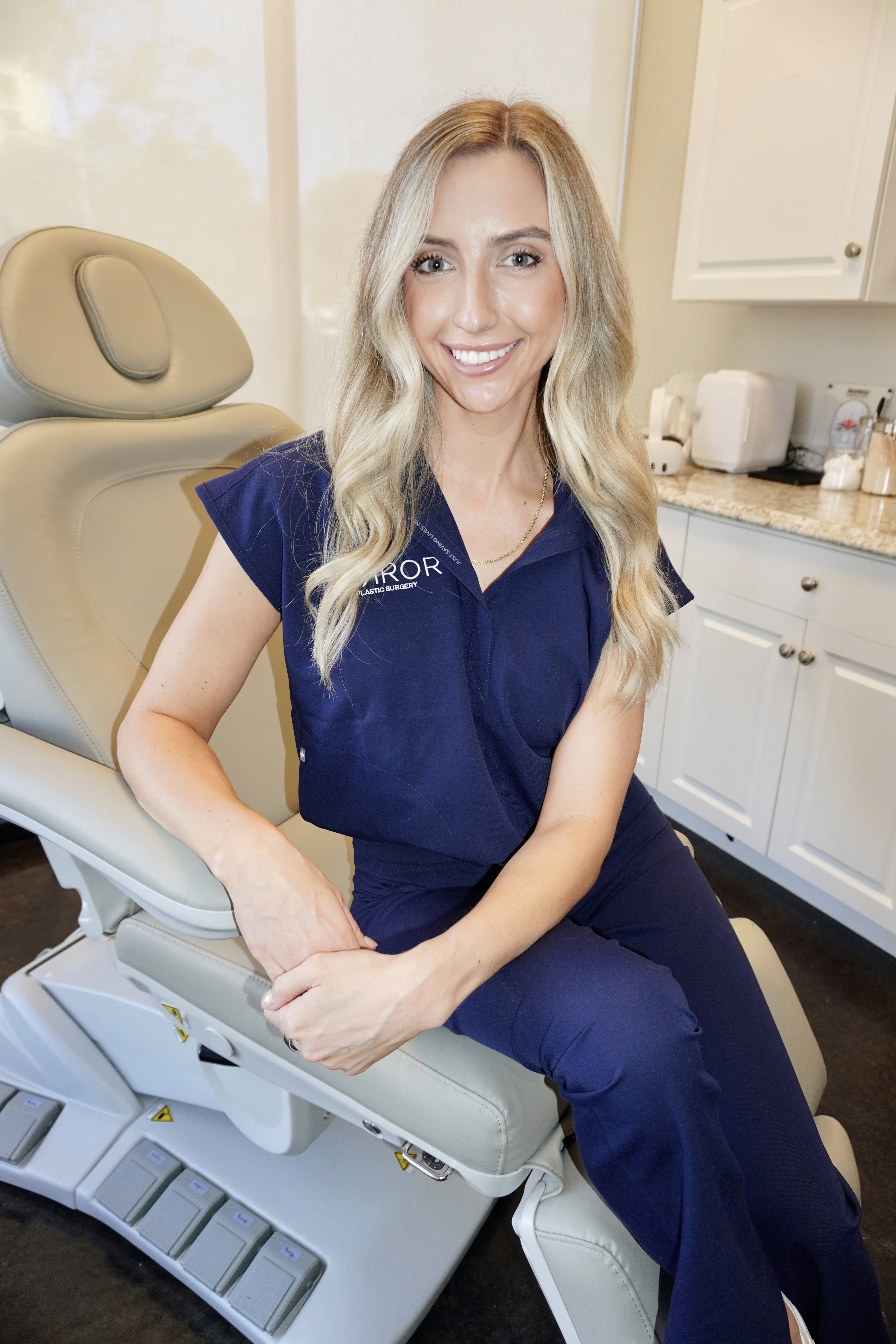
Ellie sources compounded GLP-1 peptides only from providers with documented batch testing, which confirms purity and accurate dosage and supports the stricter refrigeration requirements for compounded formulations discussed earlier. Every patient receives written reconstitution instructions, storage protocols specific to their vial’s BUD, and direct access to Ellie via text for questions between doses.
Book your initial assessment with Ellie to review your lab panels, confirm your vial’s storage requirements, and receive a personalized GLP-1 protocol with concierge-level clinical support.
Frequently Asked Questions About GLP-1 Storage
Can I store my GLP-1 pen or vial in the refrigerator door?
No. The refrigerator door experiences temperature swings every time it opens. Most GLP-1 medications require a stable 36–46°F (2–8°C) environment, which the door cannot reliably provide. Store pens and vials in the main compartment, away from the back wall, to avoid accidental freezing.
My compounded vial looks normal after being left out overnight. Is it still safe to use?
A normal appearance does not confirm potency. Denaturation and aggregation from heat exposure often remain invisible. If a compounded vial has been unrefrigerated for more than 4 hours, the safest approach is to discard it and contact your clinician before starting a replacement. Do not inject medication with an uncertain storage history.
What is the difference between a beyond-use date and an expiration date?
An expiration date appears on FDA-approved commercial pens and reflects manufacturer stability testing under controlled conditions. A beyond-use date (BUD) is assigned by the compounding pharmacy under USP <797> standards and reflects the stability of that specific compounded preparation from the date it was prepared. For compounded GLP-1 vials, the BUD on the label is the controlling date, not the expiration date of any commercial pen containing the same active ingredient.
Can I freeze my GLP-1 medication to extend its shelf life?
No. Freezing is prohibited for all FDA-approved GLP-1 pens and compounded vials. Ice crystal formation physically disrupts the peptide’s molecular structure in a way that thawing cannot reverse. As discussed throughout this guide, a frozen-then-thawed product must be discarded immediately, even if it appears completely normal, because freezing destroys the medication rather than extending its shelf life.
Does Mirror Plastic Surgery’s concierge program include storage guidance for compounded GLP-1 vials?
Yes. Every patient in Mirror Plastic Surgery’s peptide program receives written storage and reconstitution instructions specific to their vial formulation and pharmacy-assigned BUD. Ellie Pranckevicius is available via text for ongoing questions, including storage concerns, temperature excursions, and spoilage assessment. This direct clinician access is a core feature of the concierge model and is not available through unsupervised online peptide sources.
Conclusion: Protecting Every GLP-1 Dose You Take
The core rules for GLP-1 peptide storage stay consistent across commercial pens and compounded vials. Most GLP-1 medications should be refrigerated at 36–46°F (2–8°C) before use, with brand-specific or pharmacy-assigned room-temperature windows, protection from light, and strict discard of any product that freezes or shows signs of degradation. The key difference between commercial pens and compounded vials is that vials follow a pharmacy-assigned BUD under USP <797>, rather than the label of any commercial pen containing the same active ingredient.
Careful storage protects the potency of every dose you inject. Supervised sourcing from a batch-tested pharmacy, combined with direct clinician access, helps ensure that the medication you receive matches its label and that you have expert support whenever storage questions come up.
Book an appointment with Ellie at Mirror Plastic Surgery in St. Petersburg, Florida, to begin a medically supervised GLP-1 protocol with concierge-level storage support, batch-tested sourcing, and personalized clinical oversight.
Disclaimer: Compounded GLP-1 peptides are not FDA-approved drug products. They are prepared by licensed 503A or 503B compounding pharmacies under applicable state and federal regulations. Individual results vary based on health status, adherence to protocol, and other factors. This article is for educational purposes only and does not constitute medical advice. Consult a qualified clinician before beginning any peptide therapy.
1 Results may vary from person to person. Editorial content, before and after images, and patient testimonials do not constitute a guarantee of specific results.
Peptide therapy is intended for wellness and optimization purposes and is not prescribed to diagnose, treat, cure, or prevent disease unless specifically stated. Many peptides are not FDA-approved and may be used off-label. Some have limited long-term safety data, with a potential for unknown risks, complications, or desensitization with prolonged use.