Written by: Dr. Akash Chandawarkar, Board Certified Plastic Surgeon, Mirror Plastic Surgery | Last updated: September 9, 2026
Key Takeaways
- Most med spa breast enhancement options, including radiofrequency, creams, suction devices, and PRP, lack clinical evidence and do not reliably increase breast size.
- Fat transfer breast augmentation is the only proven non-implant option, with strong data supporting both safety and long-term volume retention.
- Breast lift (mastopexy) corrects sagging without adding volume and can pair well with fat transfer for patients who want both lift and modest fullness.
- Injectable fillers for breast enhancement are not FDA-approved and show significantly higher complication rates than fat grafting in published studies.
- For evidence-based breast enhancement guidance, schedule a consultation with the team at Mirror Plastic Surgery to review safe, proven options tailored to your goals.
Why Women Are Choosing Alternatives To Breast Implants
More women are exploring non-implant breast enhancement because they want meaningful results without permanent foreign materials. Concerns about breast implant illness (BII), fear of major surgery, a preference for a natural look, and dissatisfaction with previous implants all play a role. Some alternatives have solid evidence and clear safety data. Others rely on marketing claims instead of science. This guide from Mirror Plastic Surgery in St. Petersburg, FL, focuses on options supported by medical research and FDA guidance.
Schedule a consultation with Ellie to review your breast enhancement options with a board-certified plastic surgeon before you commit to any treatment.
The Only Proven Non-Implant Option: Fat Transfer Breast Augmentation
Autologous fat transfer (AFT) is the only non-implant alternative with consistent, high-quality clinical evidence. Fat is liposuctioned from areas such as the abdomen, thighs, or flanks, then purified. The surgeon injects the fat into the breasts in small, distributed parcels to maximize contact with the surrounding blood supply and improve fat survival.
A 2026 systematic review and meta-analysis in Plastic and Reconstructive Surgery Global Open concluded that AFT is “technically and surgically effective and oncologically safe.” Serious adverse events occurred in 1.2% of AFT patients compared to 10.5% of implant-based reconstruction patients. A 2026 meta-analysis in Aesthetic Surgery Journal reported a 93.1% patient satisfaction rate and 61.3% volume retention at 12 months.1 Some patients gain one to two cup sizes, although this can require more than one session and depends on anatomy and available donor fat.1
Fat transfer is a surgical procedure and not a med spa service. It requires detailed anatomical knowledge, a sterile operating environment, and precise technique from a board-certified plastic surgeon. Dr. Akash Chandawarkar, founder of Mirror Plastic Surgery, trained at Harvard and Johns Hopkins and completed a fellowship in aesthetic surgery at Manhattan Eye Ear & Throat Hospital (MEETH)/Lenox Hill Hospital. These credentials support safe planning and execution for a technically demanding procedure like fat transfer.
Request a fat transfer consultation with Ellie to learn whether this approach fits your goals and anatomy.
Some women care more about breast position and shape than volume. For them, a breast lift can address sagging while fat transfer can add subtle fullness when desired.
Breast Lift For Sagging: Restoring Shape Without Extra Volume
A breast lift (mastopexy) raises and reshapes sagging breasts without significantly changing overall size. The procedure tightens the skin envelope, repositions the nipple, and improves contour. Many patients combine a lift with fat transfer when they want both a more youthful shape and a modest increase in fullness.
At Mirror Plastic Surgery, Dr. Akash evaluates degree of ptosis, skin quality, and your aesthetic goals before recommending a lift alone or a combined plan. This individualized approach helps match surgical technique to your body and expectations.
Talk with Ellie about breast lift options if sagging is your main concern.
Unproven Med Spa Treatments: What To Avoid And Why
Many med spas promote “non-surgical breast enhancement” treatments that sound appealing but lack meaningful clinical evidence. Knowing what each option can realistically do helps you avoid disappointment and unnecessary risk.
- Radiofrequency (RF) and ultrasound devices: These devices can stimulate collagen and improve skin firmness. Tightening the skin envelope does not create true volume underneath it. No energy-based device currently holds FDA clearance for breast enhancement.
- Creams and supplements: No topical product or oral supplement has been shown to increase breast size. Products that alter estrogen pathways can also introduce hormone-related health risks.
- Vacuum or suction devices: These devices cause temporary swelling from increased blood flow. The effect fades within hours, and no credible evidence supports lasting enlargement.
- Platelet-rich plasma (PRP) “vampire breast lift”: Small pilot studies show modest improvements in skin quality. They do not show meaningful volume increase, and large randomized trials confirming long-term benefits are not available.
Injectable fillers sit in a separate category from these med spa treatments. They carry higher medical risk and receive specific FDA warnings.
Injectable Fillers For Breasts: FDA Warning And Safety Concerns
The FDA has not approved dermal fillers for breast augmentation and cautions against their off-label use near the breast. Reported complications include hard lumps, infection, filler migration, and interference with breast cancer screening, which can lead to false-positive or false-negative results. No dermal filler currently holds FDA approval for breast enhancement, and injectable silicone for breast augmentation is specifically flagged as a serious risk for injury and disfigurement.
A 2026 systematic review in JPRAS Open compared autologous fat grafting with injectable fillers for breast procedures and found higher complication rates with fillers in every category:
- Infection: 8.7% (fillers) vs. 2.1% (fat grafting)
- Migration: 18.4% vs. 1.2%
- Inflammatory reactions: 15.6% vs. 3.4%
- Granuloma formation: 12.3% vs. 0.8%
- Revision surgery: 22.7% vs. 4.3%
Dr. Akash does not offer breast filler injections and strongly advises against them. Any med spa that promotes breast fillers signals a significant safety concern.
Proven And Unproven Options: A Side-By-Side Comparison
The table below summarizes how each option stacks up in terms of evidence, type of treatment, and key risks. Use it as a quick reference while you consider which approaches deserve a deeper conversation with a surgeon.
| Option | Type | Evidence | Key Risks |
|---|---|---|---|
| Fat transfer breast augmentation | Surgical | Proven with high satisfaction and stable volume retention | Fat necrosis, oil cysts, calcifications (usually minor and self-limiting) |
| Breast lift (mastopexy) | Surgical | Proven for correction of sagging (ptosis) | Scarring, possible need for revision |
| Injectable fillers | Non-surgical | Not FDA-approved, associated with high complication rates | Infection 8.7%, migration 18.4%, granulomas 12.3% |
| RF, ultrasound, creams, suction devices | Non-surgical | No evidence of meaningful volume increase | Financial cost without lasting physical benefit |
Med Spa Or Board-Certified Plastic Surgeon: Why Training Matters
Med spas are often run by nurse practitioners or physician assistants who have limited surgical training. They can provide injectables and energy-based treatments, but they do not perform surgical procedures such as fat transfer or breast lifts. A Holland & Knight legal alert from August 2026 notes that recent state and federal enforcement actions against medical spas frequently cite unlicensed practice of medicine, inadequate medical oversight, and deceptive marketing. The FDA also issued its first Drug Supply Chain Security Act warning letter to a medical spa in April 2026, signaling closer federal scrutiny of this industry.
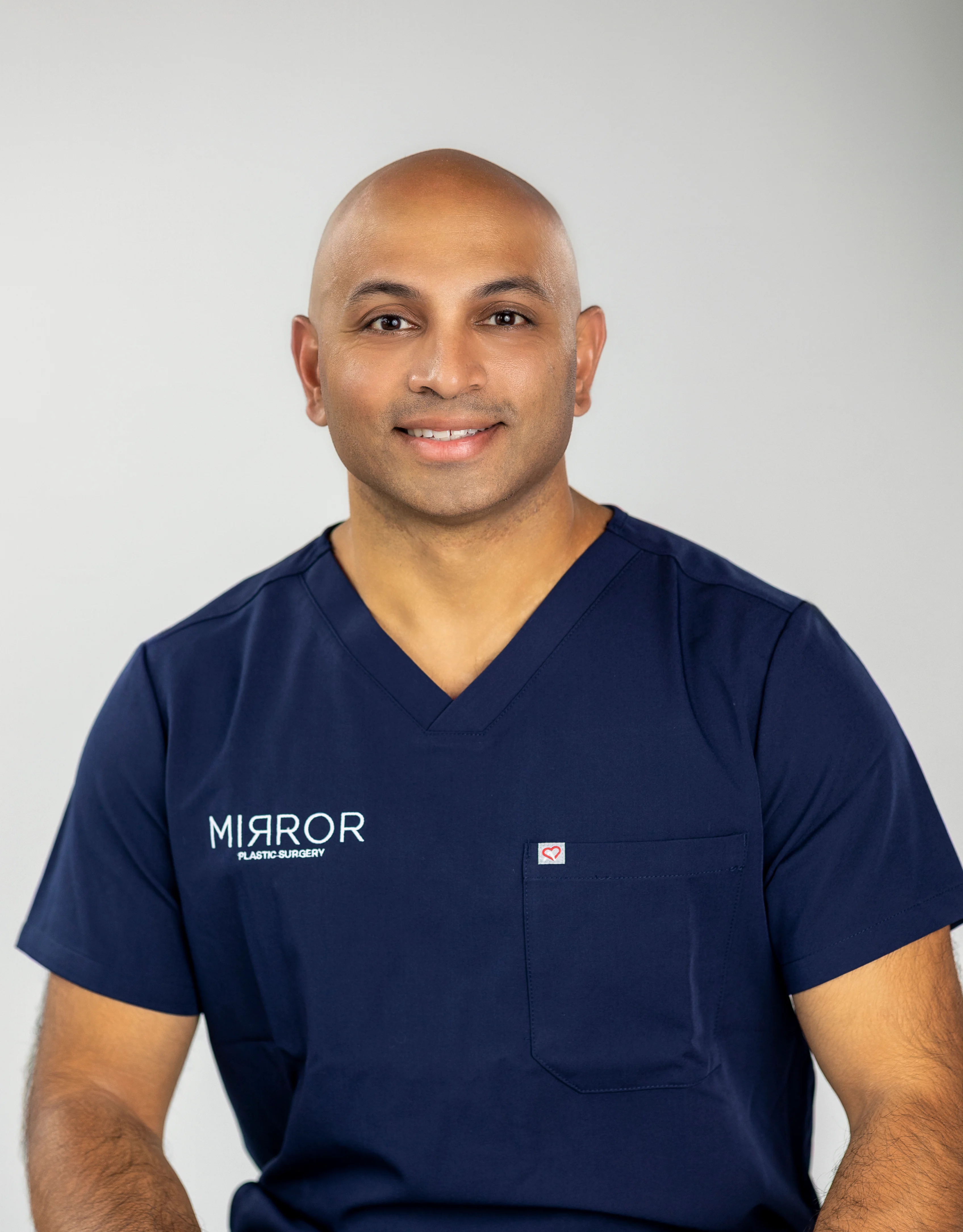
Board-certified plastic surgeons complete at least six years of surgical training and pass demanding board examinations. They develop the deep anatomical understanding needed for safe breast procedures. Dr. Akash Chandawarkar is board-certified by the American Board of Plastic Surgery. He trained at Harvard and Johns Hopkins and completed an aesthetic surgery fellowship at MEETH/Lenox Hill Hospital. He personally performs all procedures at Mirror Plastic Surgery and limits the schedule to one or two surgeries per day so each patient receives focused, individualized care.
Realistic Expectations For Fat Transfer Results
Fat transfer usually provides about a one-to-two cup size increase.1 Final results depend on your anatomy, the amount of available donor fat, and surgical technique. Volume tends to stabilize after the first three months, with long-term retention often between 50% and 70% of the grafted fat.1 A planned second session can make sense for patients who want a larger change, and very lean patients may not qualify because they lack sufficient donor fat.
Dr. Akash speaks candidly about what each patient’s anatomy can support. He sometimes recommends against a procedure when it will not meet your goals, reflecting Mirror Plastic Surgery’s focus on honest, evidence-based care instead of procedure volume.
Frequently Asked Questions
What Is The Best Non-Surgical Breast Enhancement Method?
No non-surgical method has shown reliable breast enlargement in clinical studies. Fat transfer is the only proven non-implant alternative, and it remains a surgical procedure that requires a board-certified plastic surgeon. Radiofrequency, creams, suction devices, and PRP treatments do not create meaningful volume and should not be presented as true breast enlargement solutions.
Are Breast Fillers Safe?
The FDA has not approved dermal fillers for breast augmentation and warns that off-label use near the breast can cause serious problems. Reported issues include hard lumps, infection, migration, and interference with breast cancer screening. Clinical data also show higher rates of infection, migration, granuloma formation, and revision surgery with fillers compared to autologous fat grafting.
What Is The 45-55 Rule For Breasts?
The 45-55 rule is an aesthetic guideline that suggests the ideal breast has about 45% of its volume above the nipple and 55% below. Surgeons use this proportion as a design principle during planning. It does not serve as a medical standard or a screening tool for candidacy.
Can A Med Spa Perform Fat Transfer Breast Augmentation?
Fat transfer breast augmentation is a surgical procedure that involves liposuction, careful fat processing, and strategic injection in an accredited surgical facility. A board-certified plastic surgeon must perform it. Any med spa that claims to offer fat transfer breast augmentation should be approached with serious caution.
How Long Do Fat Transfer Results Last?
Studies show volume retention of roughly 61–64% at 12 months, with some gradual loss through 24 months.1 Most loss occurs in the first three months after surgery. A second session may be recommended for patients who want more volume, and final cup size remains less predictable than with implants.
Choosing Safe, Evidence-Based Breast Enhancement
Fat transfer and breast lift surgery are the only proven non-implant breast enhancement options, and both require a board-certified plastic surgeon. Most med spa offerings, including radiofrequency, creams, suction devices, PRP, and injectable fillers, either lack evidence or carry documented safety concerns in FDA communications and peer-reviewed research. Mirror Plastic Surgery provides honest, research-based guidance for patients in the Tampa Bay area who want natural-looking results without unnecessary risk.
To explore your breast enhancement options safely, call or text Mirror Plastic Surgery at 727-361-6515, email [email protected], or schedule a consultation with Ellie online. Mirror Plastic Surgery is located at 780 4th Ave S, St. Petersburg, FL 33701.
Disclaimer: Results may vary from person to person. Editorial content, before and after images, and patient testimonials do not constitute a guarantee of specific results.
1 Results may vary from person to person. Editorial content, before and after images, and patient testimonials do not constitute a guarantee of specific results.