
Written by: Dr. Akash Chandawarkar, Board Certified Plastic Surgeon, Mirror Plastic Surgery
Key Takeaways for Cheek Filler at Mirror Plastic Surgery
- Juvéderm Voluma XC is the FDA-approved filler for deep cheek injection to correct age-related mid-face volume loss, with results lasting up to two years when treatment is planned around individual anatomy.1
- Cheek augmentation restores mid-face structure by addressing bone resorption and fat pad descent, and it works best after a full-face assessment.
- Most patients need multiple syringes for meaningful cheek augmentation, with the exact amount based on volume loss, facial structure, and whether treatment is a first session or maintenance.
- Skilled injection technique and conservative planning help prevent an overfilled or unnatural look, and physician injectors with surgical training bring the anatomical expertise needed for safe, lasting outcomes.
- Schedule a consultation with Ellie at Mirror Plastic Surgery for a personalized mid-face assessment and syringe plan from Dr. Akash.
You Have Decided on Cheek Filler: What Actually Shapes Your Result
Cheek augmentation is a structural mid-face treatment that restores facial architecture instead of adding volume to a single spot. Most patients at this stage already know the basics and now want clear answers about product choice, syringe count, how natural the result will look, and whether their injector has the right credentials.
This guide walks through those decisions step by step. Juvéderm cheek augmentation in St. Petersburg is the focus, and the information comes from FDA trial data, clinical anatomy, and the standards that separate precise, lasting results from work that needs correction.
Begin your personalized mid-face assessment at Mirror Plastic Surgery in St. Petersburg.
The Mid-Face, Volume Loss, and Why Structure Matters
The mid-face spans the area between the lower eyelid and upper lip, anchored by the zygomatic arch and malar fat pad. With age, two processes flatten this area at once. The underlying facial bones gradually resorb, and the fat compartments that once sat high on the cheekbone descend and deflate. Projection decreases, nasolabial folds deepen, and the lower face looks heavier as support from above fades.
Juvéderm Voluma XC cheek filler in St. Petersburg restores volume at the deep subcutaneous and supraperiosteal planes, directly on or just above the bone where structural support begins. This makes cheek augmentation a form of structural restoration instead of surface-level filling. Placing product in the wrong plane or treating the cheek without considering the upper and lower face can create puffiness and distortion.
Juvéderm Voluma XC uses Allergan’s Vycross cross-linking technology, which combines high and low molecular weight into a tightly cross-linked matrix. This formulation resists enzymatic breakdown better than traditional fillers, which is why its labeled duration in the cheek extends up to two years, specifically for deep cheek injection.
Biostimulatory fillers such as Sculptra take a different approach. They stimulate the body’s own collagen production over several months instead of occupying space immediately. Sculptra (poly-L-lactic acid) received FDA approval on April 25, 2023 (PMA supplement P030050/S039) for correction of fine lines and wrinkles in the cheek region in immune-competent subjects and acts as a collagen stimulator. Each option has a specific role in mid-face restoration, and the right choice depends on anatomy, timeline, and long-term goals discussed during consultation.
Have Dr. Akash evaluate your mid-face anatomy before any product decision is made.
How Cheek Augmentation Treatment Planning Typically Works
A well-structured cheek augmentation begins with a full-face assessment. The consultation looks at the upper, middle, and lower face together, including temporal volume, malar projection, nasolabial depth, jowl formation, and skin quality. Changes in one zone affect how every other zone appears, so treating the cheek without this context can create asymmetry and an overdone look.
Candidacy review follows. Ideal candidates are healthy adults over 21 with visible mid-face volume loss, no active skin infections at the treatment site, no allergy to hyaluronic acid or lidocaine, and realistic expectations about non-surgical treatment. Patients with significant skin laxity may see some improvement from filler but often need surgical tissue repositioning for full correction, and a straightforward provider explains this before placing product.
Product selection, injection planning, and follow-up timing all depend on anatomy. The aim is a result that looks like the patient’s own face at a younger, more rested stage.
How Many Syringes of Voluma XC Cheek Augmentation Typically Requires
One syringe of Voluma XC rarely creates meaningful cheek augmentation in a patient with visible mid-face volume loss. The Juvéderm Voluma XC pivotal FDA trial used a mean injection volume of 6.8 mL per patient, which is far more than the one to two syringes often mentioned in consumer content. About 82% of subjects also received a touch-up injection around 30 days after the initial treatment to reach complete correction.
Typical Syringe Ranges for Cheek Filler
Syringe count depends on anatomy and is set during consultation. These ranges show how volume loss, age, and facial structure often guide planning:
- Mild mid-face volume loss (early 30s to mid-40s): 1 to 2 syringes in the cheeks, often enough for maintenance-level correction.
- Moderate mid-face volume loss (mid-40s to early 50s): 2 to 3 syringes across the cheeks and sometimes the temples or nasolabial folds.
- Significant mid-face volume loss (late 50s and beyond): 3 to 4 syringes for meaningful restoration, sometimes combined with biostimulators over several visits.
- Facial structure: Naturally fuller faces often need less filler, while naturally angular or thinner faces may need more product to create the same visual change.
- First treatment versus maintenance: First treatments usually require the most product, while maintenance sessions often need fewer syringes.
No single syringe count works for everyone. A number that looks natural and lifted on one face can look heavy on another. Many patients benefit from a staged plan that starts conservatively and adds more at follow-up once swelling has resolved.
Get an honest syringe-count recommendation based on your specific mid-face anatomy.
Does Cheek Filler Make You Look Older, Chubby, or Overdone?
Cheek filler can make a patient look older or chubby when the injector ignores the whole face, uses too much product, or selects an unsuitable product for the cheek. Overfilling and a puffy look usually come from excessive product or poor placement rather than a problem with the filler itself.
The cheek occupies a defined three-dimensional space. Overfilling that space widens the face laterally, flattens the natural convex curve of the malar eminence, and can push volume downward into the nasolabial region, which works against a lifted result. A full-face structural plan treats the cheek in context so that mid-face volume supports surrounding anatomy instead of distorting it.
Does Cheek Filler Make You Look Older or Younger?
When planned well, cheek filler restores youthful convex projection and creates a subtle lifting vector that softens nasolabial folds and reduces the appearance of jowling.1 These changes read as younger and more rested. Poor planning with the same product can create the pillow-face look that has fueled the filler-fatigue conversation.
Filler fatigue, where patients dissolve or stop filler, often stems from years of overfilling, repeated injections without checking residual product, and treatment that focused on volume instead of structure. Patients now arrive with more information and a strong desire to avoid puffiness or an overfilled appearance. Conservative, anatomy-led treatment responds to that concern and serves as the default standard for physician injectors with surgical training.
Discuss a conservative, anatomy-led cheek plan with Dr. Akash.
When Cheek Filler Looks Its Best and How Long Voluma Lasts
Cheek filler swelling is usually most noticeable within the first 24 to 48 hours after injection. Swelling peaks around 24 to 48 hours, mostly settles within the first week, and a subtle fullness from residual swelling can linger for 1 to 3 months before the final result appears.1 Patients should avoid judging results in the first two weeks.
When Does Cheek Filler Look Its Best?
Refined results usually appear within two to four weeks as early swelling resolves and the filler integrates with surrounding tissue.1 The full result, with complete settling and integration, is typically in place at four to six weeks.1
In the pivotal FDA trial for Juvéderm Voluma XC (PMA P110033), 85.6% of treated subjects were responders at Month 6, 85.2% at Month 12, 71.5% at Month 18, and 67.1% at Month 24.1 The “up to 2 years” claim reflects a best-case duration under a protocol that allowed an optional touch-up at 30 days.1 Individual metabolism, exercise habits, sun exposure, and skin quality all influence how long results last. Many patients schedule a maintenance assessment around 12 months to plan ahead.
Allergan recommends avoiding makeup for 12 hours after treatment and limiting strenuous exercise, heavy sun or heat exposure, and alcohol in the first 24 hours, since these can increase temporary redness, swelling, or itching at the injection site.
Cheek Filler vs. Botox for Jowls and When Surgery Is the Better Option
Neuromodulators and fillers address different issues in the lower face and jowls. Botox and similar products relax muscles that pull downward along the jawline, but they do not restore volume or reposition descended tissue. Cheek filler treats structural volume loss in the mid-face and can create a lifting vector that softens jowling indirectly, although it does not tighten skin or move tissue that has dropped significantly.
Which Is Better for Jowls, Botox or Fillers?
For mild jowling driven by mid-face volume loss, cheek filler often improves the jawline by restoring support that keeps tissue elevated. For moderate or significant jowling caused by skin laxity and soft-tissue descent, Botox and filler both play supporting roles at best. Patients who need surgical tissue repositioning instead of volumetric filling are less ideal candidates for dermal fillers alone.
Surgical mid-face restoration, including facelift techniques that reposition the SMAS layer and rebuild the facial foundation, can address changes that filler cannot. At Mirror Plastic Surgery, Dr. Akash Chandawarkar performs both injectable and surgical mid-face restoration, so the consultation covers which approach, or which combination, will best serve each patient’s anatomy over time.
Find out whether cheek filler, neuromodulators, surgery, or a combination fits your specific concerns.
Who Should Inject Your Cheeks? Why Board Certification Matters
Board-certified plastic surgery training provides a level of facial anatomy knowledge that differs from aesthetic nursing or general medical training. A plastic surgeon understands the three-dimensional relationships between facial fat compartments, the vascular anatomy of the mid-face, the planes of injection, and the management of complications. That knowledge comes from years of surgical dissection and operative experience.
Complications from hyaluronic acid fillers are not completely avoidable even for highly experienced clinicians, so awareness of potential complications, prevention and management strategies, and detailed facial anatomy is essential for safe care. When a complication such as vascular occlusion, malar edema, or a delayed nodule occurs, the injector’s training and access to emergency protocols shape the outcome. A physician injector with surgical training plans cheek augmentation as full-face structural restoration instead of a quick single-syringe treatment.
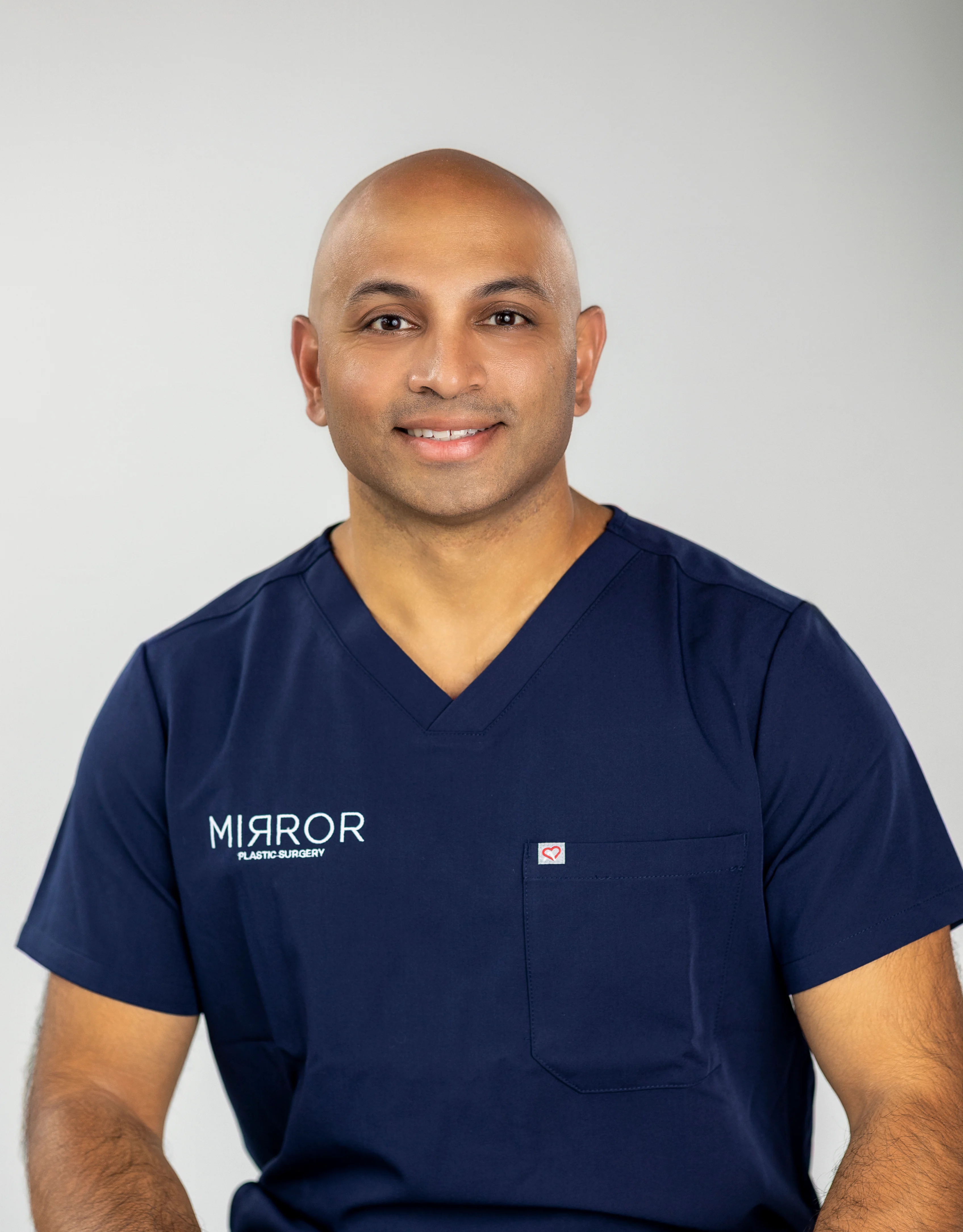
Mirror Plastic Surgery is a leading choice for Juvéderm cheek augmentation in St. Petersburg. Injectable treatments are performed by Dr. Akash Chandawarkar, a Harvard-educated physician, Johns Hopkins-trained plastic surgeon, and aesthetic surgery fellowship graduate from the Manhattan Eye Ear & Throat Hospital/Lenox Hill Hospital. He is board-certified by the American Board of Plastic Surgery and serves on the advisory board for Merz Aesthetics. Each injectable visit begins with a top-to-bottom assessment of up to an hour, evaluating the full face before any product is placed.
Mirror Plastic Surgery follows a concierge medicine model with one to two procedures per day, no quota-driven upselling, and a philosophy that places safety first, function second, and aesthetics third. The practice is located at 780 4th Ave S, St. Petersburg, FL 33701. Patients can call or text 727-361-6515 or email [email protected].
Experience a surgeon-led injectable assessment at Mirror Plastic Surgery.
Cheek Filler Product Comparison
Once you know who will perform your injections, the next step is choosing the product that fits your anatomy and goals. The table below compares three main options on FDA indication, labeled cheek duration, and reversibility.
| Attribute | Juvéderm Voluma XC | Restylane Lyft | Biostimulatory Filler (e.g., Sculptra) |
|---|---|---|---|
| FDA Cheek Indication | Approved 2013 for deep cheek injection to correct age-related mid-face volume loss in adults over 21 | Approved 2015 for cheek augmentation | Approved April 25, 2023 for correction of fine lines and wrinkles in the cheek region in immune-competent subjects; acts as a collagen stimulator |
| Labeled Duration in Cheek | Up to 2 years | Up to approximately 12–15 months, some up to 18 months | Up to 2 years in the cheek, with gradual collagen-stimulated improvement over months; the pivotal cheek study ended at 96 weeks |
| Reversibility | Reversible with hyaluronidase | Reversible with hyaluronidase | Not reversible with hyaluronidase |
Key Considerations Before Pursuing Cheek Augmentation
Patients considering Juvéderm cheek augmentation in St. Petersburg can use the checklist below to prepare for consultation and align expectations.
- Injector qualifications: Verify board certification, focused training in facial anatomy, and access to emergency hyaluronidase protocols so complications can be treated promptly.
- Anatomical approach: Confirm that the provider evaluates the full face instead of treating the cheek in isolation, which supports balanced results.
- Realistic outcomes: Clarify what filler can achieve for your degree of volume loss and skin laxity and where surgery or biostimulators may offer better support.
- Maintenance plan: Most patients plan maintenance treatment every 18 to 24 months, with a check-in around 12 months.
- Recovery needs: Plan for peak swelling in the first 48 hours and avoid strenuous exercise, alcohol, and sun exposure during the first 24 hours.
- Long-term strategy: Decide whether HA filler, biostimulatory filler, surgery, or a combination best supports your goals over the next five to ten years.
Risks, Limitations, and Common Tradeoffs
The most commonly reported side effects of Juvéderm injectable gels include redness, swelling, pain, tenderness, firmness, lumps or bumps, bruising, discoloration, and itching, and most resolve within 30 days.
More serious but rare complications include:
- Vascular occlusion: Reported incidences are below 0.1%, but risk increases in high-danger zones where connections with the ophthalmic artery can cause skin necrosis or permanent vision loss. The cheek is relatively lower risk than the nose or glabella, although vascular anatomy varies between individuals.
- Malar edema: Occurs in up to 11% of cases when hyaluronic acid fillers are placed along the tear trough, due to the malar septum acting as a barrier.
- Delayed nodules: Appear in about 0.5% of hyaluronic acid filler treatments, often between four weeks and over one year after treatment.
- Overfilling and distortion: Re-injecting full syringes without checking residual filler can create a pillow-face look and tissue distortion.
- Candidacy limits: Patients with significant skin laxity, bleeding disorders, active skin infections, or allergy to hyaluronic acid or lidocaine may not qualify for treatment.
Vascular occlusion usually appears during or right after injection with sudden, intense pain and localized blanching and must be treated as an emergency. Hyaluronidase should be available during any HA filler procedure, and the injector must know how to recognize and manage this complication immediately.
Common Misconceptions About Cheek Filler
Several myths still shape how patients think about cheek augmentation. Clearing them up helps you make more confident decisions.
- “One syringe is enough for both cheeks.” For most patients with visible mid-face volume loss, one syringe split between both sides creates only a subtle change. Meaningful augmentation usually needs more product, set by anatomy at consultation.
- “Cheek filler always looks overdone.” Overdone results usually come from overfilling or poor planning. Conservative, anatomy-led treatment can blend seamlessly with natural facial structure.
- “The ‘up to 2 years’ claim means everyone gets 2 years.” As the trial data above showed, roughly one in three patients had returned toward baseline by Month 24 and needed maintenance.
- “Any licensed injector can safely treat the cheeks.” The cheek contains complex vascular anatomy. Injector training, anatomical knowledge, and access to emergency protocols are the main safety factors.
- “Cheek filler and a mid-face lift are interchangeable.” Filler restores volume, while surgery repositions descended tissue and tightens skin. They solve different problems and sometimes work best together.
- “Recovery from cheek filler is immediate.” Typical recovery includes peak swelling at Days 1–2, gradual reduction through Days 3–5, most swelling gone by Week 1, and final results between Week 2–4 and Month 1–3.
FAQ
Is One Syringe of Voluma Enough for Cheeks?
For most patients with visible mid-face volume loss, one syringe of Juvéderm Voluma XC divided between both cheeks creates only a modest improvement. Meaningful cheek augmentation usually requires more than one syringe, with the exact count based on volume loss, facial structure, skin thickness, and aesthetic goals. Many patients benefit from a conservative starting point with a planned follow-up.
How Many Syringes of Voluma XC Do I Need for Cheek Augmentation?
Most patients fall in the range of 2 to 4 syringes for full cheek augmentation, with mild volume loss at the lower end and more advanced flattening at the higher end. Patients in their 30s with minimal hollowing may reach their goals with 1 to 2 syringes, while patients in their 50s with noticeable volume loss often need 3 or more syringes for a natural, lifted result. Syringe count is anatomy-dependent and finalized after a full-face assessment.
Does Cheek Filler Make You Look Older or Chubby?
No, when it is planned around your anatomy. The overdone look usually comes from overfilling or placing product in the wrong plane, and a full-face assessment helps prevent both. See the section above on overfilling for the detailed anatomical explanation.
Plan a conservative, anatomy-led cheek augmentation with Dr. Akash.
*Disclaimer: Results may vary from person to person. Editorial content, before and after images, and patient testimonials do not constitute a guarantee of specific results.
1 Results may vary from person to person. Editorial content, before and after images, and patient testimonials do not constitute a guarantee of specific results.