
Dermal Fillers
Written by: Dr. Akash Chandawarkar, Board Certified Plastic Surgeon, Mirror Plastic Surgery | Last updated: September 28, 2026
Key Takeaways
Dermal fillers are injectable gels, primarily hyaluronic acid, that restore facial volume and smooth lines. They differ from neuromodulators like Botox and fall into four main families with distinct longevity and reversibility.
The FDA classifies dermal fillers as medical devices. Injector credentials and complication-management skills are central to safe treatment, as emphasized by the American Society of Plastic Surgeons.
Longevity depends on product type, injection technique, treatment area, and patient factors. Biostimulatory options such as PLLA can provide effects that extend beyond two years.
Choosing a qualified injector, ideally a board-certified plastic surgeon with deep anatomical expertise and immediate access to reversal agents, greatly reduces risks such as vascular occlusion and overfilling.
Mirror Plastic Surgery Med Spa provides personalized, physician-led filler treatments in St. Petersburg, Florida, with safety-first planning and natural-looking results as core priorities.
Book Your Dermal Filler Consultation
Why Mirror Plastic Surgery Feels Different
Mirror Plastic Surgery is a concierge medicine practice in St. Petersburg, Florida. Consultations typically run up to an hour and follow a structured, top-to-bottom assessment of anatomy, emotional drivers, and long-term goals before any product recommendation. The practice limits itself to one to two surgical procedures per day so every patient, surgical or non-surgical, receives the team’s full attention before, during, and after treatment.
The guiding philosophy is safety first, function second, and aesthetics third. That sequence is the order in which treatment decisions are actually made. Because Mirror Plastic Surgery is supplier-neutral, product and brand recommendations follow a patient’s anatomy and goals rather than quotas or commissions. This approach separates the practice from high-volume “mill” clinics where speed and throughput often replace individualized care.
Schedule A Safety-First Filler Visit
Meet Your Injector: Dr. Akash Chandawarkar
Dr. Akash Chandawarkar, MD, is a Harvard-educated physician and Johns Hopkins-trained plastic surgeon with fellowship training in aesthetic surgery at Manhattan Eye Ear & Throat Hospital (MEETH)/Lenox Hill Hospital. He is board certified by the American Board of Plastic Surgery and personally performs all injectable and non-surgical treatments at Mirror Plastic Surgery. His surgical command of facial and subdermal anatomy makes injectable placement safer and more precise than treatment delivered by non-physician injectors.
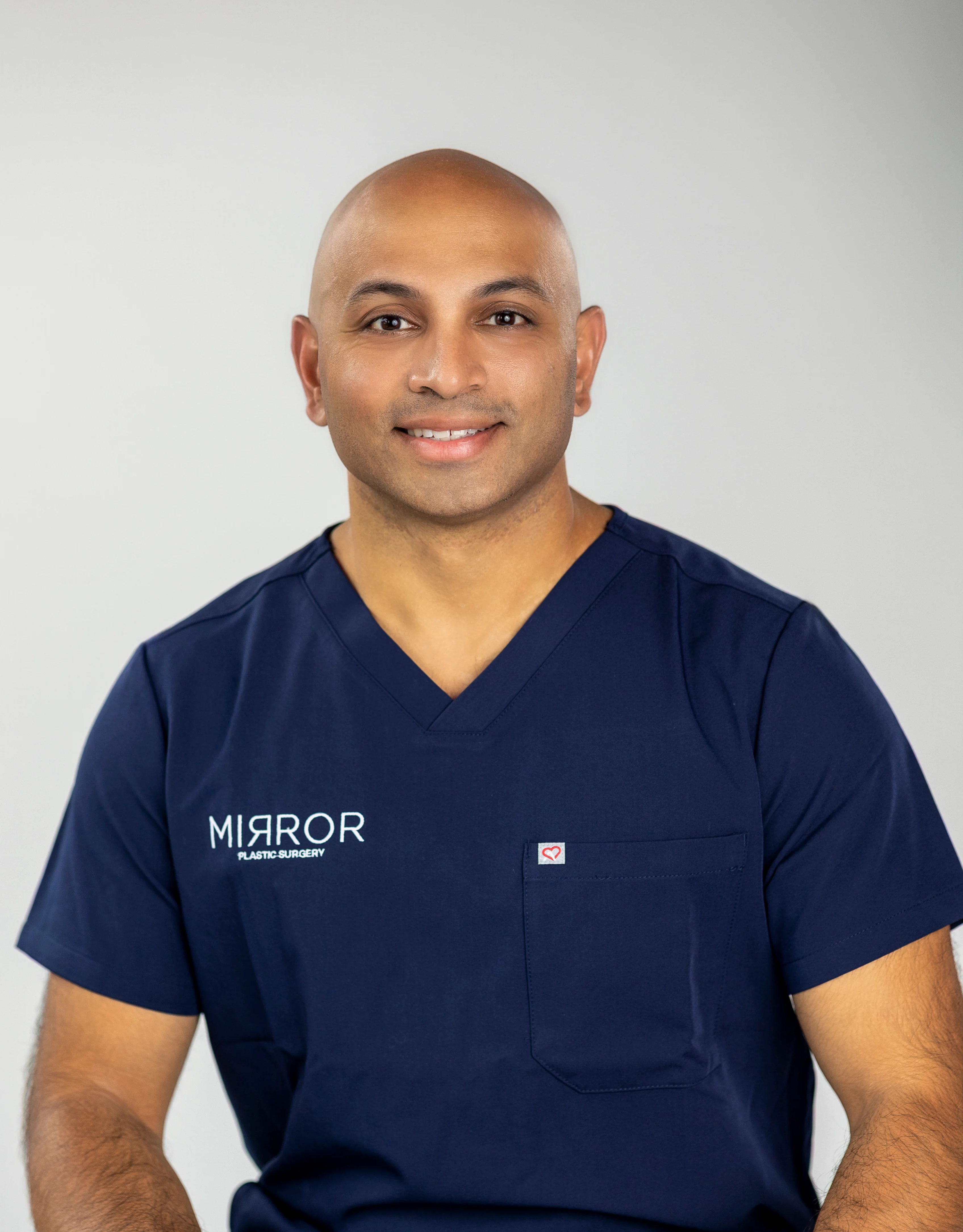
Dr. Akash serves on the advisory boards of Merz Aesthetics, the manufacturer of biostimulatory fillers such as Radiesse, and Tiger Aesthetics. His involvement in product development keeps his clinical practice aligned with the current evidence base. His approach centers on restoring and balancing inherent facial characteristics before adding volume, a philosophy that supports natural-looking results and long-term patient trust.
Types Of Dermal Fillers And How They Work
Dermal fillers restore volume, support facial structure, and hydrate tissue. They work by replacing or stimulating the structural elements that diminish with age. The four filler families differ in mechanism, reversibility, and longevity:
Hyaluronic Acid (HA) – The most widely used filler material globally, accounting for more than 5.5 million procedures in 2023 alone. HA fillers (brands include Juvederm, Restylane, RHA, Versa, and Evolysse) are reversible with the enzyme hyaluronidase, which cleaves the gel’s molecular bonds and allows the body to clear the fragments. Clinical effects generally last 4–18 months depending on product, technique, and patient factors.
Calcium Hydroxylapatite (CaHA) – Radiesse is the primary brand. CaHA consists of smooth ceramic microspheres 25–45 μm in a carboxymethylcellulose gel and exhibits the highest storage modulus among injectable biostimulators, providing immediate structural support. Significant collagen III increases are observed histologically at 4–9 months, with collagen I accumulation by 9 months post-injection. CaHA is not reversible with hyaluronidase.
Poly-L-Lactic Acid (PLLA) – Sculptra is the primary brand. PLLA is a collagen biostimulator that engages both foreign-body-reaction-dependent and mechanotransduction pathways, with tissue persistence exceeding 24 months. It builds collagen gradually over months rather than providing immediate volume. A 2025 randomized clinical trial in Aesthetic Surgery Journal found PLLA improvements for temporal hollowing sustained up to 12 months with an excellent safety profile.
Polymethylmethacrylate (PMMA) – A permanent, non-absorbable material. PMMA is not reversed by hyaluronidase, and complications may require surgical management. Its permanence requires careful patient selection and high injector expertise.
The choice between biostimulatory fillers such as CaHA and PLLA and HA fillers is a meaningful clinical decision. HA provides immediate, reversible, contour-specific results. Biostimulators provide delayed collagen-mediated tissue remodeling and are especially useful when the goal is structural regeneration rather than immediate volumization. HA fillers and biostimulators function as complementary and overlapping modalities.
Good candidates for dermal fillers are adults in good general health with realistic expectations and specific, anatomy-based goals. A thorough consultation determines candidacy. Results vary from person to person.*
Filler Family Comparison At A Glance
The table below summarizes the four filler families side by side so you can quickly compare reversibility, collagen stimulation, and typical longevity.
Filler Family | Reversible with Hyaluronidase | Collagen Stimulation | Typical Longevity Range |
|---|---|---|---|
Hyaluronic Acid (HA) | Yes | Limited biomechanical stimulus; newer formulations may elicit limited response | Within the 4–18 month range described earlier |
Calcium Hydroxylapatite (CaHA) | No | Yes, with collagen III at 4–9 months and collagen I by 9 months | |
Poly-L-Lactic Acid (PLLA) | No | Yes, through gradual collagen stimulation via M2 macrophage and mechanotransduction pathways | Effects associated with tissue persistence beyond 24 months |
Polymethylmethacrylate (PMMA) | No | Acts as a permanent scaffold and directly stimulates collagen production, inducing neocollagenesis and becoming encapsulated within new collagen fibers | Permanent, not absorbed |
How Long Dermal Fillers Really Last
Filler longevity varies widely because several factors interact. The treatment area, specific product, degree of cross-linking, injection depth, individual metabolism, and injector technique all influence how long results persist. HA gel longevity is influenced by degree of cross-linking, injection technique, treatment area, exposure to mechanical stress, and patient-related factors such as metabolism, diet, and lifestyle, which weakens the correlation between laboratory properties and clinical longevity.
A more recent MRI study reported detectable HA gel for at least 2 years in 33 cases, though MRI signal reflects a combination of injected HA, bound water, and de novo procollagen rather than product alone. Maintenance belongs in a well-designed treatment plan and does not signal failure. Mirror Plastic Surgery focuses on long-term care instead of one-off procedures, and Dr. Akash builds maintenance timelines into every patient’s plan from the first consultation.
Choosing An Injector And What To Ask
The person performing the injection is the most consequential factor in filler treatment. In no U.S. state may an esthetician or cosmetologist independently inject Botox, administer dermal fillers, or operate medical-grade lasers under their cosmetology or esthetics license. In Florida, nurse practitioners must work under physician supervision for their entire scope of practice. The Georgia Composite Medical Board states that injectable aesthetic procedures “are considered the practice of medicine” and that botulinum toxin is a dangerous drug and soft tissue fillers are medical device implants approved by the FDA.
When evaluating a provider, ask these questions directly:
Who will personally perform the injection, and what are their credentials?
What specific product is recommended, and how does it match my anatomy?
How are vascular occlusion and other complications managed if they occur?
Is hyaluronidase immediately available in the treatment room?
A thorough consultation includes an in-depth, top-to-bottom anatomical assessment, a discussion of emotional drivers and long-term goals, and a clear explanation of risks, benefits, and alternatives. At Mirror Plastic Surgery, Dr. Akash Chandawarkar personally performs every injection as a board-certified plastic surgeon with a surgeon’s command of facial and subdermal anatomy. The consultation runs up to an hour, and honest, unbiased communication remains the standard throughout.
Meet With Dr. Akash For Fillers
Natural vs. Overdone: Full-Face Sequencing
The most natural-looking filler results come from injector skill and full-face planning rather than any single product brand. When multiple facial indications are treated together, the priority sequence should be lifting → contouring → volumization → smoothening → revitalization, an order that follows biomechanical principles and aesthetic logic.
Dr. Akash’s approach at Mirror Plastic Surgery follows this structure-first philosophy. Foundational restoration that addresses support deficits in the temples, lateral cheek, and jawline comes before any central volumization. Restoring lateral structural support may reduce the need for central volumization and create a more favorable lifting-oriented vector. Isolated lip or cheek injections without this structural foundation frequently cause the “overdone” appearance patients want to avoid.
Central or medial filling applied repeatedly to tissues that have already descended may increase surface convexity without improving tissue position. The result is a face that appears fuller but not younger, wider but not better supported, and smoother but less natural. Mirror Plastic Surgery’s sequencing philosophy supports smooth transitions between the upper, middle, and lower facial regions and limits volume that lacks structural intent. Results should look like the patient, only refreshed.*
Why Some People Stop Fillers
The current filler backlash reflects real concerns. Overfilling, filler migration, poor technique, and changing aesthetic preferences all contribute to decisions to dissolve or discontinue treatment. Facial overfilled syndrome, often described as “chipmunk cheeks,” “pillow face,” or “sunset eyes,” is linked to profit-driven practices promoting high-volume injections, insufficient understanding of facial aesthetics, improper filler selection or technique, and repeated injections that create cumulative volume imbalance.
HA fillers can be dissolved with hyaluronidase, though dissolution may require multiple sessions because the dense polymer network of cross-linked HA fillers restricts enzyme diffusion, and a single treatment does not always achieve complete reversal. PMMA does not absorb and may require surgical management. CaHA and PLLA also are not reversible with hyaluronidase.
Perception drift, a gradual shift in baseline self-perception driven by repeated treatments, can lead patients to seek further or unnecessary treatment and an exaggerated, unnatural look. Dr. Akash often advises patients when an expensive service is not yet necessary, which builds trust and limits the volume accumulation that later needs correction. Conservative dosing, thoughtful full-face planning, and honest communication remain the most effective tools for avoiding the outcomes that push patients away from fillers.
Age-Specific Guidance After 50 And 60
Age alone does not disqualify someone from dermal fillers. Candidacy depends on anatomy, overall health, and goals rather than a specific number. Facial aging after 50 and 60 introduces structural changes that significantly shift the treatment approach.
After age 50, bone resorption accelerates primarily in trabecular-rich sites such as the vertebrae, pelvis, and ultradistal wrist, with slower cortical bone loss in the long bones and vertebrae. Fat pads descend and deflate. Skin thins and loses elasticity. These changes mean that simply adding HA volume to the midface may worsen heaviness rather than restore youth. Older patients with advanced laxity, severe skeletal resorption, marked soft-tissue descent, or poor dermal elasticity may need larger structural correction, surgical lifting, or combined treatment, because attempts to correct advanced ptosis with HA alone can increase facial heaviness and raise the risk of overfilling.
Biostimulatory options such as Radiesse (CaHA) and Sculptra (PLLA) become more prominent for older skin because they address collagen loss rather than only replacing volume. A 2026 meta-analysis found that effectiveness of both HA and CaHA for temporal volume loss did not correlate with age in meta-regression, and acceptable effectiveness appeared in older ages. Dr. Akash evaluates each patient’s anatomy individually to determine which filler family, or combination, fits their specific presentation.
Dermal Fillers Side Effects And Safety
Common, temporary side effects of dermal fillers include bruising, swelling, tenderness, and redness at the injection site. Minor reactions such as these often clear within about 7 to 14 days, though exact duration varies by product and patient. More persistent issues such as nodules, the Tyndall effect (a blue-gray discoloration from superficial HA placement), and delayed inflammatory reactions are less common but documented.
The most serious risk is vascular occlusion, which involves inadvertent injection into or compression of a facial artery. Vascular occlusion from filler injection is rare, with reported incidences below 0.1%, but risk rises in anatomically risky regions such as the glabella, forehead, and nose, where direct anastomoses with the ophthalmic artery can result in skin necrosis or permanent vision loss. Clinical warning signs include disproportionate pain, pallor, livedo reticularis, and delayed capillary refill.
Injector anatomy expertise is the primary risk-reduction tool. Higher-risk facial zones including the glabella, nose, forehead, temples, nasolabial fold, and tear trough should be treated only by clinically experienced injectors. At Mirror Plastic Surgery, Dr. Akash’s surgical training means he understands the precise vascular anatomy of every facial zone he treats. Hyaluronidase is immediately available for HA filler emergencies, and complication management forms part of every treatment plan.
Dermal Fillers vs. Botox
Dermal fillers and neuromodulators like Botox address different aspects of facial aging and do not replace one another. Neuromodulators relax the muscles responsible for dynamic lines such as crow’s feet, forehead lines, and glabellar creases formed by repeated muscle contraction. Dermal fillers restore volume, support facial structure, and smooth static lines that remain visible at rest.
The two often work together in a full-face treatment plan because they solve complementary problems. A neuromodulator may relax a hyperactive depressor anguli oris while a filler restores lateral cheek support, and neither treatment alone would achieve the same result. At Mirror Plastic Surgery, Dr. Akash evaluates the entire face before recommending any combination so that each modality addresses the indication it suits best.
What To Look Out For And Avoid
Several misconceptions push patients toward poor outcomes. One common misconception is that all fillers are the same product. Matching filler rheology to anatomy and injection plane is a clinical skill rather than a commodity decision. A second misconception is that more product always produces better results. A ligament-based framework supports using less filler more intelligently: clearer anatomical intent, more conservative sequencing, and greater attention to vascular safety.
Price-driven decisions create real risk. High-volume settings where injector credentials are unclear and complication management is underprepared are the environments where migration, overfilling, and vascular events most often occur. A qualified provider takes time to give a comprehensive evaluation, present the most appropriate procedures with clear reasoning, and remain available for support before, during, and after treatment.
Personalized Consultation
Every person is different and benefits from a personalized consultation. Specialized consultations allow tailored solutions. Expert assessment guides you through individualized options to achieve natural-looking facial rejuvenation with dermal fillers.*
Plan Your Personalized Filler Visit
Frequently Asked Questions
Are face fillers worth the money?
For the right candidate with realistic expectations and a qualified injector, dermal fillers can create meaningful improvements in facial volume, contour, and overall harmony. The value depends heavily on consultation quality, the injector’s anatomical expertise, and how well the treatment plan matches the patient’s actual anatomy rather than a generic protocol. Rushed, high-volume settings often produce results that later require corrective work, which costs more over time than a thorough, conservative approach from the beginning.
What is the safest filler to get?
Hyaluronic acid fillers are generally considered the most forgiving option because hyaluronidase can reverse them if a complication or unwanted result occurs. Injector expertise and technique, however, influence safety more than product choice alone. A board-certified plastic surgeon with a detailed command of facial anatomy, immediate access to hyaluronidase, and a documented complication management protocol provides a more meaningful safety margin than any specific brand or material.
What is the most natural looking filler?
Natural-looking results come from full-face planning and conservative technique rather than any single product. An injector who sequences treatment from structural support outward, uses the minimum effective volume, and evaluates the face as an integrated whole will consistently produce more natural results than one who treats isolated areas alone. Product choice matters, but the plan and the person executing it matter more.
Why are people stopping fillers?
The most common reasons include overfilling, filler migration, changing aesthetic preferences, and dissatisfaction with an “overdone” appearance that accumulates over multiple sessions. Many patients who stop fillers received treatment in high-volume settings without a coherent full-face plan, which created cumulative volume imbalance. Conservative dosing, honest communication about when treatment is not yet necessary, and a structure-first sequencing philosophy greatly reduce the chance of reaching a point where dissolving or stopping feels like the only option.
Is 60 too old for dermal fillers?
Age 60 does not automatically disqualify someone from dermal fillers. Candidacy at any age depends on anatomy, overall health, skin quality, and goals. Patients in their 60s often benefit from biostimulatory options such as Radiesse or Sculptra, which address collagen loss rather than simply adding volume. The treatment approach shifts after 60 because bone resorption, fat pad descent, and skin thinning change clinical priorities. These changes call for a refined plan rather than avoidance of treatment. A thorough consultation with a board-certified plastic surgeon is the right starting point for any patient at any age.
Book A Consultation
Dr. Akash Chandawarkar is currently welcoming new patients at Mirror Plastic Surgery in St. Petersburg, Florida. Every consultation includes ample time for a comprehensive top-to-bottom assessment, clear guidance on which treatments are appropriate and why, and dedicated support before, during, and after any procedure. Treatment recommendations follow your anatomy and goals rather than quotas or rushed decision-making.
Mirror Plastic Surgery is located at 780 4th Ave S, St. Petersburg, FL 33701. Reach the practice by phone or text at 727-361-6515, or by email at [email protected]. Follow Dr. Akash on Instagram at @mirrorplasticsurgery and @dr.akashplasticsurgery.
Request Your Mirror Med Spa Consultation
Disclaimer: Results may vary from person to person. Editorial content, before and after images, and patient testimonials do not constitute a guarantee of specific results.