
Dermal Fillers (Buttocks Contouring)
Written by: Dr. Akash Chandawarkar, Board Certified Plastic Surgeon, Mirror Plastic Surgery | Last updated: September 28, 2026
Key Takeaways
Dermal fillers for the buttocks fall into three main groups: biostimulatory fillers, hyaluronic acid fillers, and adipose fillers, each used off-label in the gluteal region.
No injectable dermal filler is FDA-approved specifically for gluteal augmentation, so safety depends heavily on the injector’s training and anatomical expertise.
Biostimulatory fillers such as Sculptra and Radiesse stimulate collagen for gradual volume and skin-quality changes, while AlloClae provides a bioactive adipose scaffold for focused contour correction.
Patients should choose board-certified plastic surgeons and avoid non-medical silicone injections and unlicensed providers to reduce complication risk.
Mirror Plastic Surgery Med Spa offers concierge-level assessments and board-certified plastic surgeon–performed injections for individualized, safety-focused gluteal contouring.
Get Your Personalized Gluteal Contouring Plan
Why Mirror Plastic Surgery’s Approach Is Different
Mirror Plastic Surgery follows a concierge medicine model that prioritizes time, attention, and safety. Each patient receives a comprehensive, up-to-one-hour top-to-bottom assessment. The practice limits itself to one to two surgeries per day so the full clinical team can focus on each individual patient. The guiding clinical hierarchy is safety first, function second, and aesthetics third. That hierarchy matters for gluteal injectables because the buttocks contain large vascular structures, and safe outcomes depend on precise anatomy and disciplined product use.
Mirror Plastic Surgery is supplier-neutral. Product recommendations reflect the patient’s anatomy and goals rather than quotas or distributor pressure. Dr. Akash Chandawarkar personally performs all injectable treatments and brings a board-certified plastic surgeon’s command of subdermal anatomy to every injection. This standard contrasts with practices where injections are delegated to non-physician staff.
Discuss Your Options With Dr. Chandawarkar
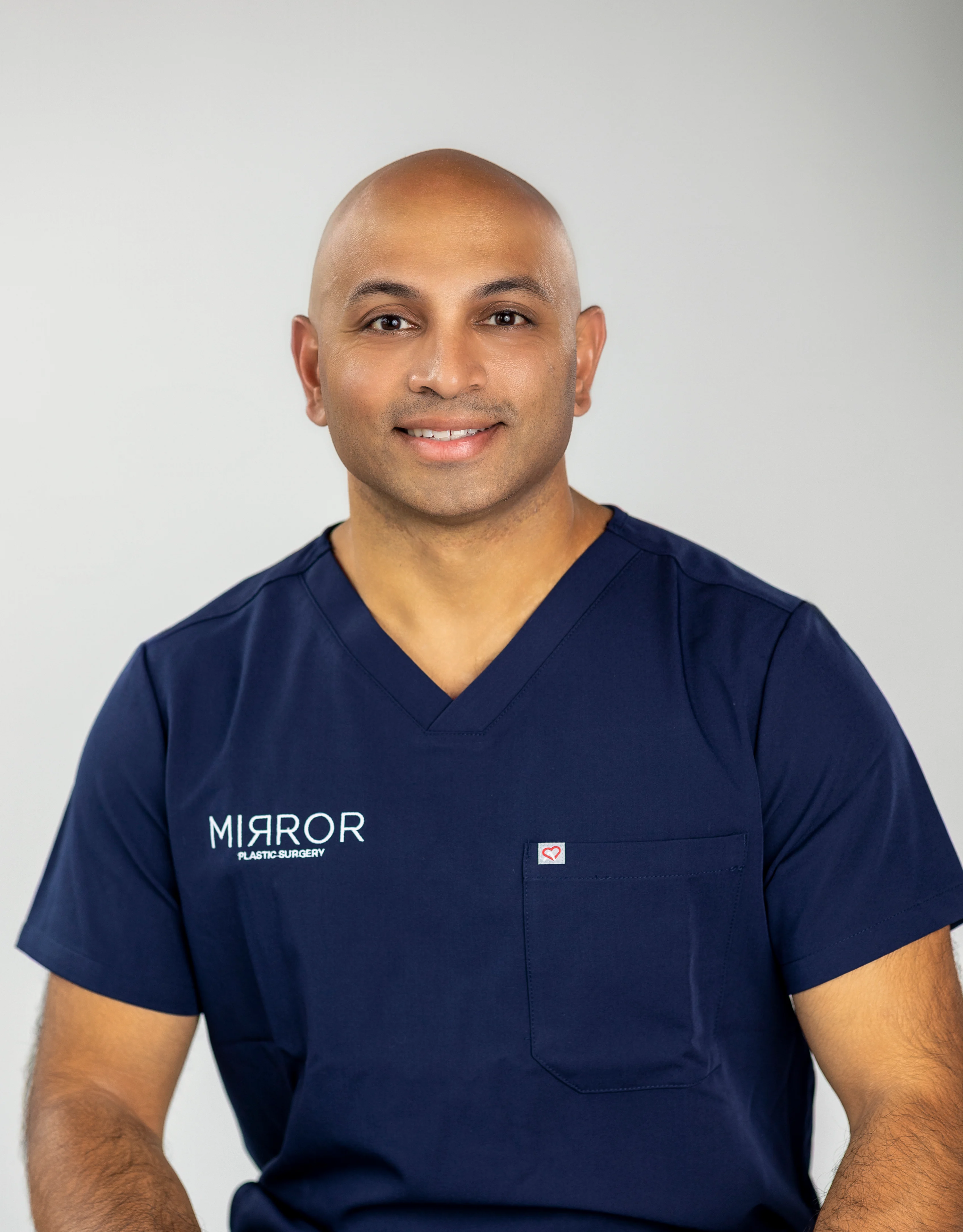
Meet Your Injector: Dr. Akash Chandawarkar
Dr. Akash Chandawarkar, MD, is a Harvard-educated physician and Johns Hopkins–trained plastic surgeon with fellowship training in aesthetic surgery at Manhattan Eye Ear & Throat Hospital (MEETH)/Lenox Hill Hospital and medical innovation training at Stanford University. He is board certified by the American Board of Plastic Surgery and personally performs all injectable treatments at Mirror Plastic Surgery, including non-surgical BBL injectables. Dr. Chandawarkar serves on the advisory boards of Merz Aesthetics, the manufacturer of Radiesse, and Tiger Aesthetics, associated with AlloClae adipose fillers and Avéli for cellulite treatment. His non-surgical BBL approach combines biostimulatory fillers to refine shape, smooth cellulite, reduce the appearance of stretch marks, improve symmetry, and correct hip dips, using regenerative medicine principles tailored to each patient’s anatomy and goals.*
Three Main Categories Of Butt Fillers
The phrase “butt filler” covers three distinct product categories with different mechanisms. Knowing how they differ helps patients make informed decisions before any consultation.
Biostimulatory Fillers: Sculptra And Radiesse
Biostimulatory fillers trigger the body’s own collagen-production machinery, which separates them from space-occupying gels. Poly-L-lactic acid (PLLA; Sculptra) works in two phases. It first creates an early mechanical expansion that fades as the carrier solution absorbs. A subclinical inflammatory response then activates fibroblasts and neocollagenesis, with predominantly type I collagen and lesser type III collagen deposition. Sculptra results develop gradually, with new collagen formation becoming clinically visible at roughly 6 to 12 weeks and further buildup through months 3 to 6, which is commonly the primary clinical assessment window, with effects described as lasting approximately 12 to 24 months, with some studies reporting results for up to 25 months. PLLA works best for mild-to-moderate gluteal volume needs, cellulite, contour irregularities, laxity, and stretch marks rather than major augmentation.
Calcium hydroxylapatite (CaHA; Radiesse) consists of microspheres 25–45 μm in diameter dispersed in a gel carrier. The carboxymethylcellulose gel carrier in CaHA provides immediate volumetric support and gradually dissipates in vivo, while the smooth CaHA microspheres activate fibroblasts through direct contact to stimulate continuous collagen production. In the gluteal region, diluted or hyperdiluted CaHA is used for sagging skin and surface contour irregularities such as cellulite and stretch marks. Clinical response duration for CaHA varies widely in the literature, ranging from about 6 to 24 months, with many studies documenting persistence of results at 12 months and beyond. Body-use dilutions for CaHA range from 1:2 to 1:6, selected according to anatomical topography, flaccidity degree, local skin thickness, and injector experience, with more dilute product used for thinner or atrophic skin.
A 2026 case series published in the Journal of Cosmetic Dermatology (Acevedo et al., J Cosmet Dermatol 2026;25(7):e71070) reported that combined subcision plus low-volume diluted CaHA was well tolerated in three female patients with gluteal cellulite, with median Cellulite Severity Scale scores falling from 12 to 3, a median 71% reduction, as rated by blinded specialists. The authors emphasized that these findings are preliminary and hypothesis-generating. A 2024 prospective clinical study by Durairaj et al. in Aesthetic Plastic Surgery (48(9):1797–1806) reported that cannula-based subcision with 1:1 diluted CaHA significantly improved Cellulite Severity Scale scores (mean decrease of 4.29 points, a 43.92% improvement at week 14) in 24 adult women with buttock cellulite dimpling; a later commentary described these gains as comparable to those of a combined subcision and low-volume 1:3 diluted CaHA protocol.
A peer-reviewed pilot histomorphometric study found that CaHA and PLLA increased fiber bundle thickness and reduced interstitial spaces in treated tissue. These findings support their collagen-stimulating, tissue-remodeling mechanism and position biostimulatory fillers as remodeling agents rather than substitutes for surgical fat transfer when major projection is the goal.
Hyaluronic Acid Fillers
Hyaluronic acid (HA) fillers such as Juvederm, RHA, Versa, Restylane, and Evolysse are water-binding gels that create immediate volume by occupying space in tissue. Upon hydration, HA forms a flexible, viscous matrix. When introduced into tissue, it attracts water to swell, restore volume, and increase thickness and moisture content, which produces immediate aesthetic improvement. That hydrating and volumizing effect is temporary, but HA fillers also act over time by stimulating collagen and remodeling the extracellular matrix. HA fillers are reversible with hyaluronidase, although the ease of reversal varies by product, and some modern fillers may require higher or repeated doses to fully dissolve. These products are not designed for large or deep soft-tissue volume in the gluteal region, and their use there is off-label. Duration in the buttocks is typically shorter than in the face because of higher mechanical loading. FDA approvals for HA fillers are indication-specific, such as midface volume deficit or lip fullness, and do not extend to body or gluteal augmentation.
Adipose Fillers: AlloClae
AlloClae is a sterile, non-viable human adipose tissue allograft (HCT/P) made from donated human fat, with donors screened and tested for communicable diseases under FDA HCT/P regulations, processed to preserve the extracellular matrix and natural 3D architecture of the donor fat while removing viable cells, free oil, and immunogenic DNA. It is regulated by the FDA as a Human Cells, Tissues, and Cellular and Tissue-Based Product (HCT/P) under Section 361 and 21 CFR Part 1271, a pathway that does not require FDA premarket approval or clearance as a drug or medical device.
A 2026 systematic review and meta-analysis by Chernoff in the Journal of Surgery found that banked human adipose tissue allograft showed a favorable safety profile, histologically confirmed host-mediated adipogenesis and angiogenesis, and a pooled clinical responder or satisfaction rate of 77.2% across 14 human studies. The review focused on small, non-randomized studies, so its pooled estimates are hypothesis-generating rather than definitive. AlloClae acts as a bioactive scaffold that recruits host adipose-derived stem cells and supports de novo host adipogenesis, a mechanism that sets it apart from the other two categories. As of mid-2026, published alloClae-specific studies have not established multi-year volume retention. The Bioengineering characterization study (Fanniel et al., 2025) reported 6-month graft retention in athymic mice and called for additional studies to quantify long-term volume retention. Peer-reviewed data have also not directly compared alloClae outcomes with conventional autologous fat grafting, although early clinical experience and non-peer-reviewed reports cite one-year retention figures of roughly 70–90%.
Because none of these three categories is FDA-approved for the gluteal region, patients also need to understand the current FDA warning before choosing a provider.
The FDA Warning: What It Actually Means
The FDA issued a safety communication warning consumers and health care practitioners about serious injuries and disfigurement from injectable silicone or products falsely marketed as FDA-approved dermal fillers for buttock enhancement. The warning focuses on injectable silicone, which is only FDA-approved for intraocular ophthalmic use. When used for body contouring, silicone has caused ongoing pain, scarring, tissue death, permanent disfigurement, embolism, stroke, infection, and death. Complications from injectable silicone may occur immediately, early, or late, and frequently result when large-volume injections of nonmedical-grade products are performed by unlicensed practitioners in nonsterile, nonprofessional environments.
The FDA’s consumer guidance advises against using dermal fillers or any injectable filler for body contouring and enhancement, including to increase breast size, increase the size of the buttocks, or implant into muscle, and warns that these unapproved uses can cause serious injury, permanent scarring or disfigurement, and death. This guidance reflects the fact that no injectable product has completed the FDA’s premarket approval process for this specific anatomical indication. In practice, the injector’s clinical judgment, anatomical knowledge, product selection, and technique become the primary safety variables.
Which Filler Is Best For Buttocks?
The best filler for the buttocks depends on the patient’s anatomy, goals, and tolerance for gradual versus faster change. A 2025 Journal of Cosmetic Dermatology report noted that calcium hydroxylapatite-carboxymethylcellulose (CaHA-CMC; Radiesse) is one of the most used biostimulators in the buttocks, and poly-L-lactic acid (PLLA; Sculptra) is increasingly used for gluteal augmentation. Sculptra builds gradual collagen over months and suits patients seeking volume, skin quality improvement, and cellulite reduction. Radiesse offers collagen stimulation with more immediate structural support and is frequently used in diluted form for cellulite and skin laxity. AlloClae, an adipose filler, works well for localized volume restoration and contour correction, especially in patients without sufficient donor fat for autologous grafting.*
“Ozempic Butt” And Post-Weight-Loss Gluteal Contouring
GLP-1 medications themselves do not directly cause the appearance changes popularly called “Ozempic butt.” The changes result from rapid weight loss, which reduces both fat and muscle, and patients cannot choose which body areas lose fat. Depending on the medication, weight loss can reach 10–25% of starting body weight, though pooled averages are lower, about 10.5% overall, 16.56% with tirzepatide, and 12.58% with semaglutide, and some individuals lose little to no weight. The combination of gluteal subcutaneous fat loss and proportional lean-mass loss, roughly 25–30% of total weight lost, can cause significant gluteal volume reduction, with skin sagging when the loss occurs rapidly. This pattern resembles other forms of rapid weight loss rather than a drug-specific effect.
Dermal fillers for the buttocks can address volume-only deficits after GLP-1-related weight loss, especially when the main concern is contour irregularity, hip dips, or mild skin laxity. When laxity dominates rather than volume loss, lift-focused or surgical approaches are usually more appropriate. Whether ongoing GLP-1 therapy changes the retention trajectory of any injectable adipose matrix, including AlloClae, remains unknown as of mid-2026. A thorough consultation helps determine whether injectables, a surgical lift, fat transfer, or a combination approach fits a given patient.*
Schedule Your Gluteal Contouring Consultation
Butt Fillers Vs. Surgical BBL Vs. Fat Transfer Vs. Implants
The table below compares the four main options on invasiveness and overall experience so patients can see how non-surgical and surgical routes differ.
Gluteal fat grafting carries the most feared complication in aesthetic surgery: fatal pulmonary fat embolism. This complication occurs when fat is injected into the deep muscle rather than the subcutaneous layer, and the ASERF Task Force found a significantly increased incidence of fatal and nonfatal pulmonary fat emboli with deep muscle injection. A 2026 retrospective study of 7,000 consecutive BBL procedures performed between 2018 and 2024, using a standardized subcutaneous-only protocol with stiff cannulas, retrograde technique, sacral and lateral access, and multimodal thromboembolism prophylaxis, reported zero cases of pulmonary fat embolism, fat embolism syndrome, deep vein thrombosis, or pulmonary embolism. Florida now requires physicians performing gluteal fat grafting to use ultrasound guidance, or equivalent technology, to confirm fat placement in the subcutaneous space above the fascia overlying the gluteal muscle. These surgical safeguards matter because injectable fillers trade that risk profile for a different one: they are non-surgical and temporary, and none is FDA-approved for this indication, while implants carry their own risks of capsular contracture and revision surgery.
Preparation
The Mirror Plastic Surgery consultation for gluteal fillers builds on the comprehensive assessment described earlier. Dr. Chandawarkar reviews anatomy, skin quality, degree of laxity, volume deficit, cellulite severity, and symmetry before recommending any product. The number of vials or syringes and the specific product or combination are determined at consultation based on individual anatomy and goals rather than a preset package.
Pre-treatment instructions include avoiding blood-thinning medications and supplements to reduce bruising risk, with specific timing: aspirin is held for one week and NSAIDs for five days before injectable procedures, while high-dose vitamin E, ginkgo biloba, and garlic are stopped two weeks prior. Patients should arrive with clean skin and disclose any recent illness, vaccination, or dental procedure, because these factors can affect timing for biostimulatory fillers. The timeline from consultation to treatment day depends on the complexity of the plan and product availability.
Once treatment is complete, the recovery experience varies based on which products were used.
Recovery
After gluteal injections, patients can expect soreness, swelling, and mild bruising at the injection sites, with bruising and swelling typically resolving within 1 to 2 weeks and discomfort usually subsiding within a few days to a few weeks. Results from biostimulatory fillers develop over weeks to months, with the earliest honest visible results around three months and peak results typically at five to six months after treatment.* Patients should avoid direct pressure on the treated area and strenuous exercise for a period specified by Dr. Chandawarkar based on the products used. After PLLA (Sculptra), the 5-5-5 massage rule applies: massage for five minutes, five times daily, for five days to help distribute the product evenly and reduce nodule risk. Specific activity restrictions, including sitting and exercise guidance, are reviewed at the post-treatment appointment.
What To Look Out For And Avoid
Several misconceptions about gluteal fillers can expose patients to unnecessary risk, so addressing them directly helps patients choose safer options.
The most dangerous misconception is that all “butt fillers” are equivalent. Injectable silicone, which accounts for most severe adverse events and deaths in this space, is not a legitimate medical filler. In 2017, two Miami spa operators, Bella Beauty Spa owner Maribel Jimenez and her assistant Magaly del Rosario, were sentenced to federal prison for illegally injecting smuggled Colombian silicone into hundreds of clients, who suffered irreversible injuries including silicone migration throughout the body. Any provider offering “permanent” buttock filler or injecting in a non-clinical setting should be avoided.
Results from legitimate biostimulatory and adipose fillers are temporary, which is why maintenance treatments are built into the clinical plan. Providers who promise permanent results with these products are misrepresenting the science. That same honesty should extend to anatomy. The gluteal region is a complex injection site that contains large vascular structures, and injecting the wrong plane or product can cause serious complications. The injector’s anatomical training remains the most important safety variable.
Before any gluteal filler procedure, patients should ask their provider the following questions:
Are you board certified by the American Board of Plastic Surgery or the American Board of Dermatology?
What is the exact product name, and what is its FDA regulatory status for this indication?
How many vials or syringes are planned, and what is the rationale for that number?
Who performs the injection, you personally or a delegated staff member?
What is your complication management protocol, and do you have hyaluronidase on hand if an HA filler is used?
At Mirror Plastic Surgery, every one of these questions has a clear answer. A board-certified plastic surgeon performs each injection after a comprehensive pre-treatment assessment and remains available for support before, during, and after the procedure.
Cost
Pricing for gluteal fillers reflects each patient’s anatomy, goals, and product plan. The investment depends on the specific products selected, the number of vials or syringes required, and whether a single session or a staged treatment plan makes the most sense. These factors are reviewed transparently at consultation. Mirror Plastic Surgery bases recommendations on clinical need rather than quota-driven upselling.*
Get A Personalized Cost Estimate
Frequently Asked Questions
How Do I Choose Between A Biostimulator And An Adipose Filler?
Choice between biostimulatory fillers and adipose fillers depends on whether the priority is gradual collagen remodeling or localized fat-like volume. Sculptra (poly-L-lactic acid) suits patients seeking gradual collagen stimulation, mild-to-moderate volume improvement, and skin quality enhancement, with effects developing over several weeks and lasting up to about two years in some patients. Radiesse (calcium hydroxylapatite) replenishes collagen and elastin, provides more immediate structural support, and is FDA-approved for several facial and hand indications, with results shown to last up to two years in those areas. AlloClae, a human adipose tissue allograft, is best suited for subtle-to-moderate localized volume restoration and contour correction, especially hip dips and soft-tissue depressions, particularly in patients without sufficient donor fat for autologous grafting. Hyaluronic acid fillers can provide immediate volume but are not designed to replicate the outcomes of surgical gluteoplasty for large or deep augmentation, and their effect is temporary, with an estimated duration of about 16.16 months in this mechanically loaded region. A comprehensive consultation with a board-certified plastic surgeon helps match product choice to anatomy and goals.*
How Long Do Butt Fillers Last?
Longevity varies by product category and individual response. Sculptra results can last up to about two years, with some clinical study patients showing effects beyond that window. Radiesse (CaHA) in the gluteal region lasts approximately 12 to 18 months, and maintenance sessions may be advised around that time. Global expert consensus recommends three sessions spaced 4–6 weeks apart, with follow-up at 9–12 months to evaluate the progressive volumizing effects. AlloClae’s longevity is still being defined in the literature. Real-world reports describe results lasting one to three years, with possible maintenance or top-up treatments as data mature. A 2023 systematic review of 10 studies (168 patients) estimated hyaluronic acid effectiveness for gluteal augmentation at about 16.16 months, shorter than typical facial persistence because of greater mechanical loading. None of these injectables produces permanent results, so realistic expectations include future maintenance.*
Is Bum Filler Safer Than A BBL?
Safety comparisons between bum filler and BBL focus on different risk types rather than a simple ranking. Injectable fillers in the gluteal region carry risks such as nodule formation, delayed inflammatory reactions including foreign-body granulomas, and the theoretical risk of vascular occlusion near major vessels, with some complications appearing months to years after injection. These risks decrease significantly when a board-certified plastic surgeon with deep anatomical expertise performs the injections. Surgical BBL (gluteal fat grafting) carries the risk of pulmonary fat embolism (PFE), historically the deadliest complication in aesthetic surgery and a key reason BBL once held the highest mortality rate among aesthetic procedures. Modern subcutaneous-only protocols and real-time ultrasound guidance have reduced fat embolism risk, with the ABCS survey showing mortality falling from 1:11,400 (2 of 22,800 cases, 2016–2018) to zero (0 of 12,800 cases, 2019–2021). Florida’s 2019 rule mandating subcutaneous-only injection further reduced, but did not eliminate, risk. As the 7,000-procedure study cited above showed, contemporary subcutaneous-only protocols can drive embolic events to zero in experienced hands. The choice between injectable and surgical approaches depends on goals, anatomy, degree of volume deficit, and risk tolerance. A board-certified plastic surgeon is best positioned to guide that decision.*
Can Fillers Fix “Ozempic Butt”?
Fillers can help some, but not all, GLP-1-related changes in the buttocks. GLP-1-related gluteal volume loss reflects rapid reductions in subcutaneous fat and lean or muscle mass, and because fat loss is not site-selective, patients cannot choose where they lose fat. Resistance training and adequate protein can influence the muscle component, and genetics, sex, age, and baseline body composition shape how the buttocks respond. When the main concern is volume deficit and contour irregularity without major skin laxity, gluteal fillers, particularly biostimulatory fillers or AlloClae, may provide meaningful improvement. When skin laxity dominates, lift-focused or surgical approaches usually work better, and nonsurgical energy-based treatments alone are unlikely to match surgical lift results. A tailored consultation clarifies which path fits each patient’s pattern of change.*
What Is The Difference Between Sculptra And Radiesse For Buttocks?
Both Sculptra (poly-L-lactic acid, PLLA) and Radiesse (calcium hydroxylapatite, CaHA) are biostimulatory fillers that stimulate collagen rather than simply occupying space. The main differences involve timing, dilution, and typical use. Sculptra’s result is largely delayed. The carrier solution absorbs within days, and the collagen-building response unfolds over weeks to months, with results clearest around three months. Post-treatment massage helps distribute the product and reduce nodule risk. Radiesse provides more immediate structural support from its gel carrier while CaHA microspheres stimulate collagen over time. In the gluteal region, injectors typically use diluted or hyperdiluted Radiesse for cellulite and skin laxity rather than as a bolus for projection. Sculptra is often preferred when the goal is gradual volume and skin quality improvement over multiple sessions. Radiesse is frequently chosen for cellulite dimpling and surface irregularities, sometimes combined with subcision. Both require multiple sessions and maintenance. The right choice, or combination, depends on anatomy, skin quality, and specific aesthetic goals.*
Book A Consultation
Dr. Akash Chandawarkar welcomes new patients seeking non-surgical gluteal contouring at Mirror Plastic Surgery in St. Petersburg, Florida. Every consultation begins with a detailed assessment, and no product is recommended until he understands your anatomy, goals, and medical history.
Mirror Plastic Surgery is located at 780 4th Ave S, St. Petersburg, FL 33701. Patients can call or text 727-361-6515, or email [email protected]. Follow the practice on Instagram at @mirrorplasticsurgery, @dr.akashplasticsurgery, and @perfectlyplastics.
Start Your Non-Surgical BBL Journey
Disclaimer: Results may vary from person to person. Editorial content, before and after images, and patient testimonials do not constitute a guarantee of specific results.