
Dermal Fillers (Décolleté Contouring)
Written by: Dr. Akash Chandawarkar, Board Certified Plastic Surgeon, Mirror Plastic Surgery | Last updated: September 28, 2026
Key Takeaways
Décolleté filler is a non-surgical injectable that improves crepey texture, fine lines, and volume loss on the upper chest. Most uses remain off-label. Radiesse currently has an FDA indication for décolleté wrinkle correction when used with the approved dilution protocol.
The chest’s thin dermis, minimal subcutaneous fat, and high UV exposure create unique anatomical challenges. Biostimulatory fillers like Radiesse or Sculptra help rebuild collagen instead of simply adding volume.
Safety considerations include vascular occlusion risk, possible interference with breast cancer screening, and specific contraindications for patients with breast cancer history or prior chest radiation. Physician-level expertise is essential.
Qualified injectors complete indication-specific training for Radiesse décolleté use, perform comprehensive assessments, and clearly explain off-label status, risks, and realistic outcomes without pressure or upselling.
Mirror Plastic Surgery Med Spa prioritizes safety-first care. Board-certified plastic surgeon Dr. Akash Chandawarkar personally performs all injectables using evidence-based product selection and honest patient guidance.
Book A Décolleté Consultation At Mirror Plastic Surgery Med Spa
Décolleté Vs. Décolletage Vs. Cleavage: Clinical Terms Explained
These three terms are frequently used interchangeably, yet they describe related but distinct areas.
Décolleté refers to the upper chest area, meaning the skin and soft tissue exposed by a low neckline, extending from the collarbones to the top of the breasts.
Décolletage is the French term for the same anatomical region and is used interchangeably with décolleté in aesthetic medicine.
Cleavage refers specifically to the intermammary space, the area between the breasts, which sits within the broader décolleté.
The distinction matters clinically. Radiesse’s safety labeling explicitly states that injections should not be made in an area overlying or including breast tissue. Filler for skin quality on the décolleté is a fundamentally different procedure from filler intended to enhance breast volume. Breast volume enhancement with filler is not FDA-approved and carries distinct risks.
Contouring Vs. Rejuvenation: These two goals carry different risk profiles. Contouring implies volume enhancement or breast augmentation, which the FDA specifically warns against for fillers. Rejuvenation targets skin quality, crepey texture, and fine lines, which aligns with Radiesse’s décolleté wrinkle indication. This article addresses rejuvenation only.
Why Chest Skin Needs Different Treatment Than The Face
The chest is not simply facial skin positioned lower on the body. Several anatomical differences directly affect product choice, injection technique, and complication risk.
Thin Dermis: Ex vivo analysis comparing facial and mammary dermis shows that chest (mammary) dermis is thinner than facial dermis, although breast dermis can be among the thickest when compared with other body sites. Thinner dermis means less structural support, more visible crepey texture, and tighter limits on how much volume can be placed safely.
Minimal Subcutaneous Fat: Unlike the face, the chest has little underlying fat to camouflage irregularities. Product placed too superficially can become visible or palpable.
High Cumulative UV Exposure: The periocular region, neck, and décolleté combine relatively thin skin with repetitive motion and chronic ultraviolet exposure. This combination accelerates collagen and elastin breakdown.
Sternal And Clavicular Contours: The bony landmarks of the chest create distinct planes. Precise placement is required to avoid lumps and nodules.
Crepey skin on the chest stems from collagen and elastin loss, dermal thinning, and reduced hydration rather than volume loss alone. Biostimulatory fillers that rebuild collagen are therefore preferred over traditional volumizing fillers for this area.
Good Candidates typically have crepey texture, fine lines, or mild volume loss and are in good overall health. They are not pregnant or breastfeeding, have no history of breast cancer or radiation to the chest, and understand whether the proposed treatment is on-label or off-label.
Patients Who Should Not Be Treated include those who are pregnant or breastfeeding, those with active skin infection or inflammation near the treatment site, and those with a history of breast cancer, familial breast cancer, or prior radiation to the upper chest. Patients with a history of lymphoma or other blood cancers, or those currently undergoing breast cancer treatment or PET-CT imaging, should also avoid this treatment.
Product Science: Biostimulatory Vs. HA Fillers For The Chest
Two main filler categories are used on the chest, and they work in fundamentally different ways.
Biostimulatory Fillers such as Sculptra (poly-L-lactic acid) and hyperdiluted Radiesse (calcium hydroxylapatite) stimulate collagen production over time. They are the primary tools for crepey chest skin because they address underlying collagen loss instead of simply adding volume. Hyaluronic Acid (HA) Fillers such as Juvederm, RHA, Restylane, and Versa add immediate volume and hydration. On the chest, they play a limited superficial smoothing role and can be dissolved with hyaluronidase if needed.
For crepey chest skin, the core problem is collagen loss rather than volume deficit. Biostimulatory fillers therefore target the root cause. Hyperdiluting Radiesse 1:2 with saline lowers its elastic modulus (G'). That lower modulus allows the product to diffuse across a larger area, stimulating collagen without adding unwanted bulk.
The pivotal trial supporting Radiesse’s décolleté indication randomized 152 patients 3:1 to treatment or untreated control. At week 24, blinded evaluators found a responder rate of 71.2% in the treatment group versus 6.3% in the control group. Treatment-emergent adverse events occurred in 11.7% of treated patients, all mild to moderate.
Each product differs in what it does, whether it can be reversed, and how long results last. These three factors should guide product selection for the chest.
Radiesse (CaHA): Stimulates collagen, elastin, and proteoglycans. Carries an FDA indication for décolleté wrinkles with the approved dilution protocol. No enzymatic reversal agent, so results remain while the product resorbs. Long-lasting results (see Realistic Results section).
Sculptra (PLLA): Used off-label for the décolleté. A 9‑month open-label study in the Journal of Drugs in Dermatology found most participants had at least a one-point wrinkle improvement, high satisfaction, and only one treatment-related adverse event. No reversal agent.
HA Fillers (Juvederm, RHA, Restylane, Versa): Provide immediate volume and hydration with a limited role on the chest. Reversible with hyaluronidase.
For body contouring applications beyond the face and hands, Mirror Plastic Surgery also offers treatments for the neck, hands, upper knees, and buttocks. Each area has its own anatomical considerations and product rationale, distinct from the décolleté.
Whatever product is chosen, the décolleté carries safety considerations that are not always discussed openly. The next section explains what you need to know before consenting to treatment.
The Honest Safety Section: What No One Else Will Tell You
Off-Label Status: Most dermal fillers are not FDA-approved for body contouring. Radiesse currently holds the only U.S. injectable biostimulator indication that includes décolleté wrinkle correction, and only when used with the approved dilution, depth, and age criteria. All other décolleté filler use remains off-label. The FDA explicitly warns that injectable silicone and products falsely marketed as FDA-approved for body enhancement can cause serious injuries and disfigurement.
Vascular Occlusion Risk: The chest’s vascular anatomy demands a physician-level injector. Inadvertent intra-arterial injection can cause tissue necrosis, scarring, and, in rare cases, vision loss or stroke. Filler-associated vascular occlusion affects approximately 0.015% of patients, although this figure may be underestimated. Prevention rests on four habits: knowing the vascular anatomy, using a cannula where appropriate, injecting small microboluses under low plunger pressure, and keeping the needle tip moving at all times. Because CaHA fillers have no enzymatic reversal agent, complications rely more heavily on prevention, supportive care, and in select cases mechanical removal.
Breast Cancer Screening Interference: In fall 2025, the FDA convened a panel of dermatologists, plastic surgeons, oncologists, and radiologists to discuss décolletage filler safety. The panel cautioned that fillers could cause false positives on breast imaging or make it harder to see cancer on mammograms. Unlike breast implants, dermal fillers are not encapsulated and cannot be separated from breast tissue during imaging. The panel recommended that patients planning décolleté filler stay current on mammograms and communicate openly with their imaging team.
Radiesse Contraindications: Radiesse carries a specific contraindication for patients with cancer or previous radiation treatment near the treatment area and for patients who have had breast cancer, a history of breast cancer, or a familial history of breast cancer. Safety and effectiveness have not been established beyond 84 weeks in the décolleté.
Common Misconceptions: Décolleté filler improves skin quality and texture. It will not lift the breasts or replace surgery, and it is not a breast-enhancement procedure.
With those limits in mind, it helps to see how filler compares with other options for crepey chest skin.
Discuss Your Décolleté Safety Questions With Dr. Chandawarkar
Modality Comparison: How To Reverse Crepey Skin On The Chest
The table below compares five main options for crepey chest skin across mechanism and downtime. Radiesse is the only filler with a décolleté indication; the others rely on off-label or adjunctive evidence.
Modality | Mechanism | Study Design / Evidence Type | Downtime |
|---|---|---|---|
Décolleté Filler, Radiesse 1:2 (On-Label) | Biostimulation of collagen, elastin, proteoglycans | Randomized controlled trial, décolleté-specific | Minimal; temporary bruising or swelling |
Sculptra (PLLA), Off-Label | Collagen stimulation via poly-L-lactic acid | Open-label décolleté study with clinical improvement | Minimal; temporary bruising or swelling |
Fractional CO2 Laser + HA Skinboosters | Ablative resurfacing with collagen remodeling plus HA hydration | Prospective multicenter study including décolleté | Median 3 days |
Microneedling | Controlled micro-injury that stimulates collagen induction | Collagen stimulation documented; limited chest-specific data | 1–2 days of redness |
Topical Retinoids | Increased cell turnover and collagen production | Long-term improvement with consistent use; no décolleté RCTs | No downtime; possible irritation |
Best Filler For Décolletage: Radiesse (CaHA) is the only filler with an FDA indication for décolleté wrinkles. Sculptra (PLLA) is used off-label with supportive evidence. HA fillers play a limited superficial role. The choice between Radiesse and Sculptra depends on anatomy, skin quality, and goals.
Realistic Results And Maintenance
For décolleté collagen stimulation with poly-L-lactic acid (PLLA), most patients find two to three vials cost-effective, one vial per session. Sessions are typically spaced one month apart. Three to four treatments at least four weeks apart are generally considered optimal. Radiesse results on the décolleté have been shown to last up to 1.5+ years. Customized CaHA dilution protocols have reported sustained clinical improvements lasting 12 to 30 months.
Dr. Akash Chandawarkar likens aesthetics to dentistry. Professional treatments deliver results, and lasting outcomes depend on consistent maintenance at home. Sun protection and topical retinoids function like daily brushing and flossing. Expect improvement in skin texture, firmness, and crepey appearance; the goal is healthier skin, not a return to your 20s. Results may vary.
How To Vet A Qualified Injector For Off-Label Chest Treatment
A proper consultation for décolleté filler follows a clear structure.
A comprehensive top-to-bottom assessment, not just a quick look at the chest.
An honest discussion of off-label status, risks, and alternatives.
Clear product-selection rationale that explains why a specific product fits your anatomy.
A no-pressure environment without upselling or limited-time pricing tactics.
FDA requirements mandate that healthcare providers complete an indication-specific training program before using Radiesse for décolleté treatment. This training covers the dilution protocol, advanced cannula techniques, chest and décolleté anatomy, and safe subdermal placement. Start by asking whether the injector has completed this training, since it is the only credential specific to décolleté Radiesse. Then ask who actually performs the injection, whether a physician, nurse, or esthetician, because that answer reveals the level of anatomical expertise behind the needle. Finally, ask what happens if you have a complication, which shows whether the practice has a real protocol or plans to improvise.
Several red flags signal a practice to avoid. An expanded pool of medical and non-medical providers, including some med-spas and medical tourism settings, increases complication and medicolegal risk. Be cautious with high-volume clinics that prioritize speed over individual attention, heavily discounted or aggressively promoted filler services, and any provider who cannot explain the difference between contouring and rejuvenation or who promises breast enhancement with filler.
Why Mirror Plastic Surgery Is The Right Choice For Décolleté Filler In St. Petersburg/Tampa
Mirror Plastic Surgery is built on a foundation of safety first, function second, and aesthetics third. Every injectable is performed personally by Dr. Akash Chandawarkar, a Harvard-educated physician and Johns Hopkins-trained, board-certified plastic surgeon with aesthetic surgery fellowship training at MEETH/Lenox Hill and medical innovation training at Stanford.
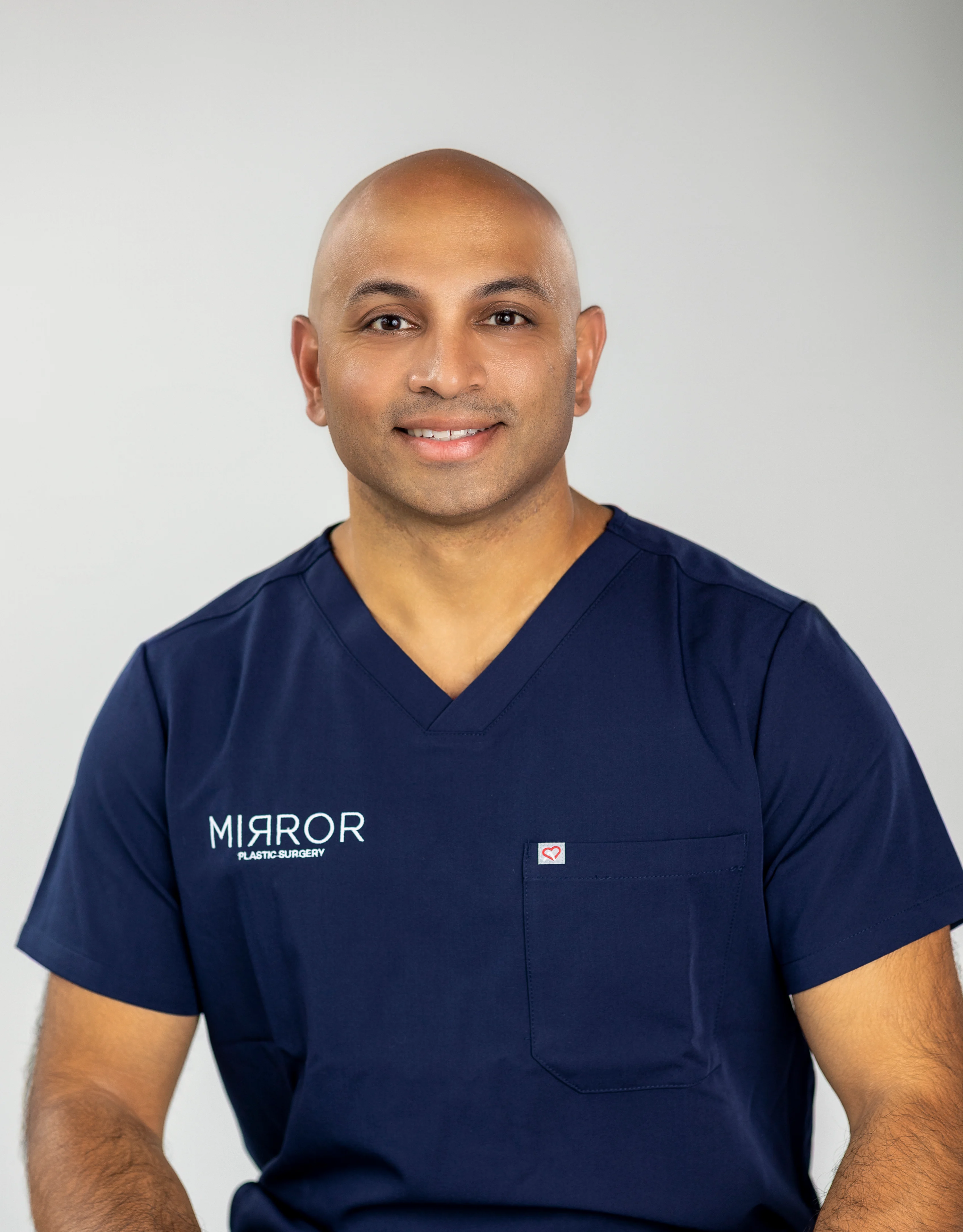
Key differentiators include:
Concierge Medicine: Up to an hour-long consultation, a top-to-bottom assessment, and a limit of one to two procedures per day so the team’s focus remains entirely on you.
Physician-Performed Injectables: Every neuromodulator and dermal filler is placed by a board-certified plastic surgeon with a surgeon’s command of chest and subdermal anatomy.
Advisory Board Expertise: Dr. Akash serves on advisory boards for Merz Aesthetics (Radiesse) and Tiger Aesthetics, giving him direct insight into the products he uses while maintaining a supplier-neutral, evidence-based approach.
Versatile Product Portfolio: Juvederm, RHA, Versa, Restylane, Radiesse, Evolysse, plus neuromodulators Botox, Dysport, Xeomin, Daxxify, and Jeuveau. Product choice is tailored to your anatomy and goals.
The Honesty To Say No: Dr. Akash is known for advising patients when an expensive service is not necessary yet. For off-label décolleté treatment, that honesty is a critical qualification.
See Why Patients Choose Mirror For Décolleté Care
Frequently Asked Questions
What Is The Best Treatment For Décolletage Wrinkles?
The best treatment depends on your primary concern. For crepey texture and collagen loss, hyperdiluted Radiesse (CaHA) is currently the only filler with a décolleté indication. Sculptra (PLLA) is used off-label with supportive clinical evidence. For overall skin quality and tone, fractional CO2 laser resurfacing combined with HA skinbooster injections has shown significant improvement across multiple skin-quality domains in clinical study. For mild texture changes and early aging, microneedling and topical retinoids offer effective maintenance. A board-certified physician can match these options to your anatomy, skin type, and health history.
How Do You Reverse Crepey Skin On The Chest?
As described above, crepey chest skin stems primarily from collagen and elastin loss rather than simple volume deficit. Rebuilding collagen becomes the central goal. Biostimulatory fillers like Radiesse and Sculptra support this over time, while sun protection and topical retinoids help prevent further damage. Laser resurfacing and microneedling also stimulate collagen through different mechanisms. A combination plan tailored to your skin, health history, and goals usually works best. Patients with a history of breast cancer, radiation to the chest, or familial breast cancer risk should review these factors with their physician before considering any injectable treatment.
Is Décolletage The Same As Cleavage?
Décolletage refers to the entire upper chest area exposed by a low neckline, from the collarbones to the top of the breasts. Cleavage refers specifically to the intermammary space between the breasts. This distinction matters clinically because filler for skin quality on the décolleté is a different procedure from filler intended to enhance breast volume. Breast volume enhancement with filler is not FDA-approved and carries distinct risks, including interference with breast cancer screening and potential for serious complications.
Is Décolleté Filler Safe, And Is It Off-Label?
Most décolleté filler use in the United States remains off-label. Radiesse holds a décolleté wrinkle indication when used with the FDA-approved dilution and technique described earlier. Safety depends on the injector’s anatomical knowledge, product selection, and technique. The FDA has warned that unapproved products and unlicensed providers can cause serious injuries. Patients with a history of breast cancer, familial breast cancer, prior radiation to the upper chest, or who are pregnant or breastfeeding should not receive this treatment. Always consult a board-certified physician.
How Long Do Décolleté Filler Results Last?
Results typically last 6 to 24 months, depending on the product used and individual metabolism. Radiesse décolleté results have been shown to last up to about 1.5 years in clinical data. Sculptra results develop gradually over several months as collagen forms and may persist for a similar duration. Maintenance treatments help sustain results. Neither Radiesse nor Sculptra has an enzymatic reversal agent, so results remain while the product resorbs naturally. Results may vary.
Book A Consultation
Choosing who performs your treatment is the most important decision in décolleté filler or contouring. Dr. Akash Chandawarkar personally performs all injectables at Mirror Plastic Surgery, bringing board-certified plastic surgery expertise and a concierge, safety-first approach that includes the honesty to tell you when filler is the wrong choice.
Mirror Plastic Surgery is located at 780 4th Ave S, St. Petersburg, FL 33701. Call or text 727-361-6515, or email [email protected].
Schedule Your Décolleté Consultation
Disclaimer: Results may vary from person to person. Editorial content and patient information do not constitute a guarantee of specific results. Always consult a board-certified physician before considering any injectable treatment.