
Energy-Based Skin Tightening
Written by: Dr. Akash Chandawarkar, Board Certified Plastic Surgeon, Mirror Plastic Surgery | Last updated: September 28, 2026
Key Takeaways
Energy-based skin tightening uses ultrasound, radiofrequency, or lasers to stimulate collagen for gradual firmness and contour improvement without surgery.
Results develop slowly and work best for mild to moderate laxity in patients in their late 30s to mid-50s.
Ultherapy reaches the SMAS layer for brow and submental lift, while Morpheus8 focuses on dermal remodeling, texture, and acne scarring.
These treatments cannot remove excess skin or replace surgical facelifts, neck lifts, or brow lifts for advanced laxity or significant sagging.
Mirror Plastic Surgery Med Spa offers physician-led, supplier-neutral consultations that match the right technology to each patient’s anatomy and goals.
Get Your Personalized Treatment Plan
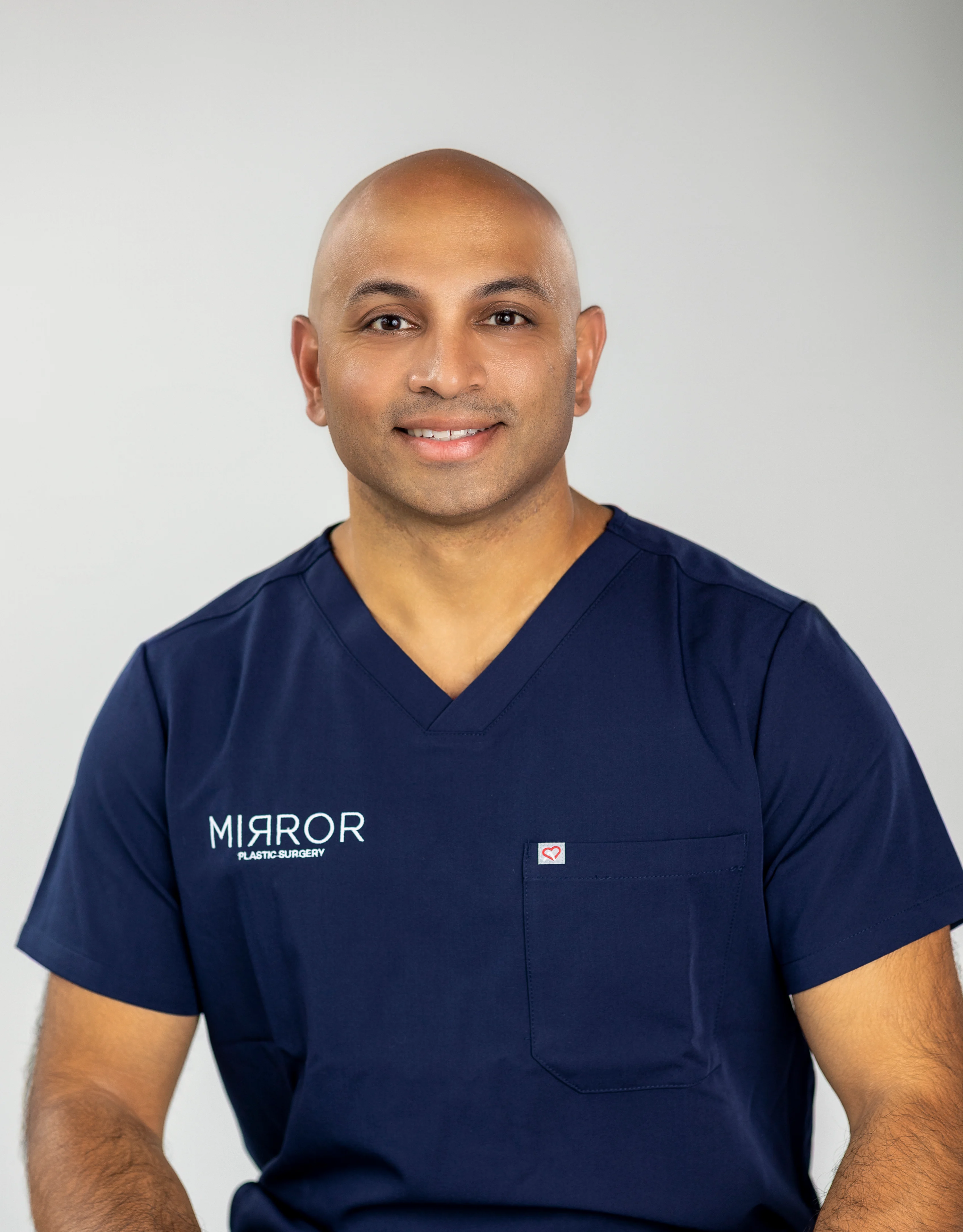
Meet Your Provider: Dr. Akash Chandawarkar
Dr. Akash Chandawarkar, MD, is a Harvard-educated physician and Johns Hopkins-trained plastic surgeon with fellowship training in aesthetic surgery at Manhattan Eye, Ear & Throat Hospital (MEETH)/Lenox Hill Hospital and medical innovation training at Stanford University. He is board certified by the American Board of Plastic Surgery and serves as an advisory board member for Merz Aesthetics and Tiger Aesthetics. Dr. Akash personally performs the practice's energy-based and non-surgical treatments, bringing a surgeon's command of facial and subdermal anatomy to every treatment plan. That same anatomical depth informs his surgical work.
Schedule Your Physician-Led Assessment
How Energy-Based Skin Tightening Works
Energy-based tightening follows three clear steps.
Controlled heat reaches the deeper layers of the skin, such as the dermis, subcutaneous tissue, or the superficial musculoaponeurotic system (SMAS), depending on the device and depth setting.
Existing collagen fibers contract once they reach a thermal threshold, which creates a subtle, same-session change in tissue tone.
A wound-healing cascade activates fibroblasts to produce new collagen and elastin over the following months. This remodeling phase creates most of the visible improvement.
The four main energy-based device families used in clinical practice are:
Microfocused Ultrasound / HIFU exemplified by Ultherapy (Merz Aesthetics), which delivers thermal coagulation points at 1.5 mm, 3.0 mm, and 4.5 mm depths, reaching the SMAS layer.
Monopolar Radiofrequency exemplified by Thermage FLX (Solta Medical), which heats deep dermal and subcutaneous tissue to 55–65°C for collagen contraction and remodeling.
RF Microneedling exemplified by Morpheus8 (InMode) and Profound. Morpheus8 combines 24 gold-coated microneedles with bipolar radiofrequency energy. Its adjustable depths range from 0.5 to 7 mm, while other RF microneedling devices such as Profound typically range from 0.5 to 4.0 mm.
Laser fractional CO₂, erbium, and non-ablative wavelengths (1064 nm, 1320 nm, 1540 nm) that heat the dermis via photothermal energy. These devices primarily improve texture, pigmentation, and fine lines, with modest tightening.
The American Academy of Dermatology's framing is accurate and worth repeating: results from these energy-based devices are modest and gradual, not surgical.
The table below summarizes how the main device families compare on treatment areas and how long results typically take to appear and last.
Technology Type | Device Names | Primary Treatment Areas | Typical Timeline to Results |
|---|---|---|---|
Microfocused Ultrasound / HIFU | Ultherapy PRIME, Sofwave | Brow, submentum, neck, décolleté, abdomen, arms, knees | |
Monopolar Radiofrequency | Face, neck, body, upper eyelids | ||
RF Microneedling | Face, neck, submentum, body, acne scars | ||
Laser (Non-Ablative / Fractional) | Fraxel, CO₂ fractional, erbium | Face, neck, chest, hands | Several months; collagen improvement may remain visible for a year or longer |
Matching Technology To Your Main Concern
Jowls
Laxity-dominant jowling responds best to microfocused ultrasound (Ultherapy) or RF microneedling (Morpheus8). This pattern occurs when skin and soft tissue loosen over a structurally intact foundation rather than from excess fat or bone loss. Ultherapy reaches the SMAS at 4.5 mm, the same plane a surgeon addresses during a facelift. Morpheus8 remodels the dermis and superficial subcutaneous layer. Realistic expectations focus on softening early jowl definition rather than erasing a pronounced jowl.
Neck
For laxity-dominant neck concerns, RF microneedling and HIFU form the core non-surgical options. The neck's dermal layer is thinner than the face and more age-sensitive, so precise energy delivery matters. Horizontal neck lines ("tech neck") and mild submental laxity often respond to these modalities. Platysmal banding and significant skin redundancy require surgical correction.
Brow
Ultherapy holds the only FDA clearance that specifically includes the word "lift" for the brow. Pooled clinical data report mean eyebrow elevation of 0.47 to 1.70 mm, which creates a real but subtle change. Patients with significant brow ptosis usually benefit more from a surgical brow lift.
Body
Ultherapy now carries FDA clearance for the abdomen, arms, and knees. Morpheus8 Body treats stretch marks and laxity on larger body areas. These options help when laxity is mild to moderate. A body lift remains the appropriate choice for patients with significant post-weight-loss skin excess.
Best Non-Surgical Options For Sagging Jowls
Expert consensus recommends phenotype-guided selection. The right treatment depends on what actually drives the jowl. Laxity-dominant jowling, where skin and soft tissue have loosened over a stable foundation, responds to energy-based remodeling with Ultherapy or Morpheus8. When the jowl reflects volume excess, fat compartment descent, or significant mandibular bone resorption, energy-based devices address only one part of a complex problem. A physician-led assessment that evaluates bone, fat, muscle, and skin separately offers the most reliable match between treatment and anatomy.
Ultherapy vs. Morpheus8 And How RF Compares To Ultrasound
Ultherapy (microfocused ultrasound with visualization) and Morpheus8 (RF microneedling) are the two most-requested energy-based devices for facial laxity. They work differently enough that comparison needs to focus on mechanism and depth, not just brand names.
Depth and Mechanism: Ultherapy delivers discrete thermal coagulation points at 1.5 mm, 3.0 mm, and 4.5 mm, reaching the SMAS, which is the deepest non-surgical target available. It also provides real-time ultrasound imaging so the provider can confirm energy placement before firing. Morpheus8 delivers bipolar RF energy through 24 gold-coated microneedles at adjustable depths of 0.5–7 mm. This approach remodels the dermis and superficial subcutaneous layer with fractional precision.
Best-Fit Concerns: Ultherapy works well when the goal is brow elevation, submental lift, or SMAS-level stimulation with no downtime. Morpheus8 fits best when goals include skin texture, acne scarring, pore size, or dermal remodeling alongside tightening.
RF vs. Ultrasound Skin Tightening: Ultrasound bypasses epidermal melanin entirely and targets deep fascial planes, which makes it safe across all Fitzpatrick skin types with minimal pigmentation risk. RF energy also bypasses melanin and is safe across all skin tones. Its depth and heating pattern depend on electrode configuration. Monopolar RF heats broadly, while RF microneedling concentrates energy at the needle tip for more focal remodeling.
RF Skin Tightening: What It Can And Cannot Do
Non-Invasive RF (e.g., Thermage FLX): Thermage FLX heats deep dermal and subcutaneous tissue to 55–65°C, which causes immediate collagen contraction and new collagen deposition over time. There is no downtime, and patients return to normal activity immediately. It is the only device FDA-cleared for non-invasive upper eyelid tightening.
RF Microneedling (e.g., Morpheus8): Recovery follows a defined timeline: redness peaks at day one and softens over 48–72 hours, with pinpoint marks lasting three to seven days and most patients returning to work at day three to five. Topical numbing is applied 45–60 minutes before treatment.
FDA October 2025 Safety Communication On RF Microneedling: The FDA issued a safety communication in October 2025 highlighting fat loss risk at aggressive depths, particularly in the lower face and jowl area. Excessive RF heating at depth can injure adipose tissue and worsen hollows and jowls. A 2026 commentary in the Journal of Cosmetic Dermatology confirms that stronger device settings are not inherently superior. Insufficient heating may fail to stimulate remodeling, while excessive exposure may cause fat injury, burns, dysesthesia, or scarring. Physician-performed treatment with a surgeon's anatomical knowledge helps match energy settings to tissue depth rather than to a device's maximum output.
Evidence That Skin Tightening Devices Work
A 2026 systematic review found that blinded evaluations indicated overall improvement in 75% of HIFU-treated patients, with progressive enhancement across sessions. A 2026 prospective study of 40.68-MHz unipolar RF showed blinded clinician improvement ratings of 88.5% at 20 weeks. A 2023 prospective study of 110 Morpheus8 patients reported a 31% reduction in skin laxity scores and 47% improvement in patient-rated satisfaction at six months. These results show real, measurable change for the right patient, with the right device, in qualified hands. They do not match surgical outcomes, so expectations need to stay within that range.
How Much Tightening Non-Surgical Treatments Can Achieve
Non-surgical skin tightening improves skin quality but cannot reduce skin quantity. Energy-based devices stimulate collagen remodeling, improve dermal architecture, and create modest tissue contraction. They cannot excise redundant skin folds, reposition descended fat compartments, or repair separated platysmal bands. Patients with significant hanging skin after major weight loss, or those seeking dramatic structural lifting, usually benefit more from surgery. This limitation reflects the physical and anatomical boundaries of the technology.
Best Age Range For RF Skin Tightening
Most clinicians agree that the late 30s to mid-50s is the window in which the average patient achieves the most satisfying results. Energy-based tightening relies on the skin's regenerative capacity, specifically fibroblasts that produce new collagen, and that capacity declines with age. Patients in this range usually present with mild to moderate laxity and retain enough fibroblast activity to mount a meaningful remodeling response. Patients in their 60s and beyond can still benefit, although results tend to be more restrained when laxity and volume loss are advanced. Younger patients in their late 20s to early 30s may use these treatments preventively, although visible change remains subtle when laxity is minimal. Age is only one variable. Skin quality, degree of laxity, sun damage history, and smoking status all modify how the skin responds.
Who Is A Good Candidate For Skin Tightening
Good candidates for energy-based skin tightening generally share these characteristics:
Mild to moderate skin laxity, such as early jowling, mild neck looseness, or slight crepiness
Good baseline skin elasticity and fibroblast activity, often seen in patients in their late 30s to mid-50s
Realistic expectations for gradual, modest improvement rather than surgical-level lifting
No active skin infections, open wounds, or cystic acne in the treatment area
No implanted electronic devices (pacemakers, defibrillators) or metallic implants in the treatment field
Not pregnant or breastfeeding
No isotretinoin use within the past six months
No active herpes simplex outbreak in the treatment area
Energy-based skin tightening is not appropriate for:
Patients with significant excess skin or advanced laxity, because the technology cannot remove or reposition redundant tissue
Patients with pronounced jowling, heavy neck folds, or platysmal banding that require surgical correction
Patients following major weight loss with large areas of draping skin
Patients with active thyroiditis, since treatment should be deferred to prevent thyroid inflammation
Patients with a strong history of keloid or hypertrophic scarring without careful provider evaluation
When Surgical Procedures Give Better Results
A patient with good skin quality but significant jowling and neck laxity needs a surgical facelift. No combination of Ultherapy, Thermage, and RF microneedling can reposition tissue the way a deep-plane or SMAS facelift does. A facelift physically removes excess skin, repositions descended fat compartments, and addresses the SMAS with mechanical force that energy-based devices cannot match. A neck lift corrects platysmal banding and submental fat in ways that surface RF and ultrasound cannot reach. A brow lift typically elevates the brow by only a few millimeters, with pooled long-term averages of about 3.25 mm medially, 3.86 mm centrally, and 4.35 mm laterally. HIFU's 0.47–1.70 mm mean elevation cannot match that magnitude in advanced ptosis.
Mirror Plastic Surgery's position is unique because Dr. Akash performs both non-surgical and surgical procedures. The recommendation you receive reflects what your anatomy requires rather than what a practice happens to offer. When surgery offers a better long-term result, you will hear that clearly, along with the reasoning.
How To Evaluate A Treatment Plan
A thoughtful treatment plan should match the device, settings, and session count to your anatomy and goals. A personalized consultation allows a physician to examine your skin quality, degree of laxity, facial structure, and medical history before recommending any device.
Key elements of a strong plan include a clear explanation of why a specific device fits your concern, a realistic description of expected change, and a defined point for reassessment. A provider who recommends a long series of sessions without interim evaluation, or who cannot explain the choice of device in plain language, may not be centering your outcome.
Mirror Plastic Surgery holds no supplier commissions, so device selection follows your anatomy and goals rather than a sales target.
How To Choose A Provider
Strong credentials provide a safer starting point. Look for board certification in plastic surgery or dermatology, verifiable state licensure, and documented experience with the specific device being recommended. The ASDS recommends that any RF microneedling treatment be performed by, or under the direct supervision of, a board-certified dermatologist or plastic surgeon. Physician-performed treatment matters because energy titration, including depth, power, and pass count, requires anatomical judgment that preset protocols cannot replace.
Red flags of upselling tend to cluster around pressure and evasion. A provider who pushes same-day booking with "today-only" offers, promises permanent results from non-invasive treatments, or refuses to discuss limitations and unsatisfactory-outcome rates may be prioritizing revenue over results. By contrast, a provider who tells you an expensive service is not necessary yet often signals a patient-first approach.
Mirror Plastic Surgery's concierge medicine philosophy means Dr. Akash spends up to an hour in consultation before making any recommendation. His board certification, surgical training, and supplier-neutral position help ensure that your treatment plan reflects your anatomy rather than a device manufacturer's sales cycle.
Discuss Surgical And Non-Surgical Options
Below are answers to questions patients most often ask about energy-based skin tightening.
Frequently Asked Questions (FAQ)
Is Morpheus8 Better Than Ultherapy?
Neither device works better for every patient. Ultherapy reaches the SMAS at 4.5 mm, which makes it a strong choice for brow elevation, submental lift, and deep fascial stimulation with no downtime. Morpheus8 delivers RF energy through microneedles at adjustable depths, so it fits better when goals include skin texture, acne scarring, pore refinement, or dermal remodeling alongside tightening. Morpheus8 involves redness that peaks at day one and softens over about 48–72 hours, with pinpoint marks typically lasting three to seven days. Ultherapy involves no surface downtime. A physician-led assessment remains the most reliable way to choose between them.
Can I Have RF Tightening In My 60s?
Many patients in their 60s can still benefit from RF tightening, although results tend to be more subtle. Fibroblast activity slows with age, and laxity and volume loss often progress, so the skin cannot remodel as dramatically as it can in earlier decades. Treatment in this age group works best for patients with relatively good skin quality and realistic expectations for gentle improvement rather than dramatic lifting.
How Many Sessions Will I Need?
Session count depends on the device, your baseline laxity, and your goals. Some HIFU and monopolar RF protocols use a single session followed by observation over several months. RF microneedling and many laser protocols often involve a series of sessions spaced weeks apart. Your provider should explain the full plan, including when to reassess and how maintenance fits into your long-term strategy.
What Does Recovery Look Like?
Non-invasive RF and HIFU treatments usually involve little to no downtime, with temporary redness or swelling that resolves quickly. RF microneedling creates pinpoint marks and redness that typically improve over several days, as described in Morpheus8 studies. Laser recovery varies by depth and aggressiveness, ranging from mild redness to several days of visible flaking or bronzing. Your provider should review expected recovery in detail before treatment.
Book A Consultation With Mirror Plastic Surgery
Energy-based skin tightening offers real benefits for the right patient, the right concern, and the right treatment depth. An honest assessment helps determine whether these devices fit your goals or whether a facelift, neck lift, or brow lift would deliver a better long-term result. At Mirror Plastic Surgery, that assessment comes from a board-certified plastic surgeon who performs both surgical and non-surgical options and maintains a supplier-neutral stance.
Mirror Plastic Surgery is located at 780 4th Ave S, St. Petersburg, FL 33701. Call or text 727-361-6515, or email [email protected]. Follow the practice on Instagram at @mirrorplasticsurgery, @dr.akashplasticsurgery, and @perfectlyplastics.
Get Started With A Consultation
Disclaimer: Results may vary from person to person. Editorial content, before and after images, and patient testimonials do not constitute a guarantee of specific results.