
Hair Restoration
Written by: Dr. Akash Chandawarkar, Board Certified Plastic Surgeon, Mirror Plastic Surgery | Last updated: September 28, 2026
Key Takeaways
Hair restoration works through three mechanisms: slowing further loss with medications, regrowing dormant follicles with PRP or laser therapy, and replacing permanently lost hair via surgical transplant.
Success depends on accurate diagnosis, pattern stability, and donor density; patients with unstable or rapidly progressing loss should stabilize medically before considering surgery.
Transplanted hair is permanent, while native hair around grafts continues to thin without ongoing medical management, so a sequenced plan is essential for long-term results.
Choosing an experienced, physician-led practice supports honest candidacy assessment, evidence-based recommendations, and dedicated follow-up instead of high-volume, sales-driven care.
Mirror Plastic Surgery Med Spa provides concierge, physician-led hair restoration in the Tampa Bay area with a focus on safety, function, and natural aesthetics.
Start Your Hair Restoration Consultation
Why Mirror Plastic Surgery For Hair Restoration In Tampa Bay
Mirror Plastic Surgery is a concierge medicine practice serving St. Petersburg and the broader Tampa Bay area. The practice limits itself to one to two surgeries per day, so the entire clinical team can stay focused on each patient before, during, and after the procedure. Consultations run up to an hour and involve a top-to-bottom assessment. The visit centers on education and planning rather than a scripted sales presentation.
The guiding principle is safety first, function second, aesthetics third. That order keeps recommendations supplier-neutral and evidence-based, with no product quotas or pressure to add unnecessary services. High-volume practices often process five to ten patients per day and rely on commercial coordinators rather than physicians to drive treatment decisions, which can shift the focus away from long-term outcomes.
Schedule Your Candidacy Assessment
Meet Your Physician: Dr. Akash Chandawarkar
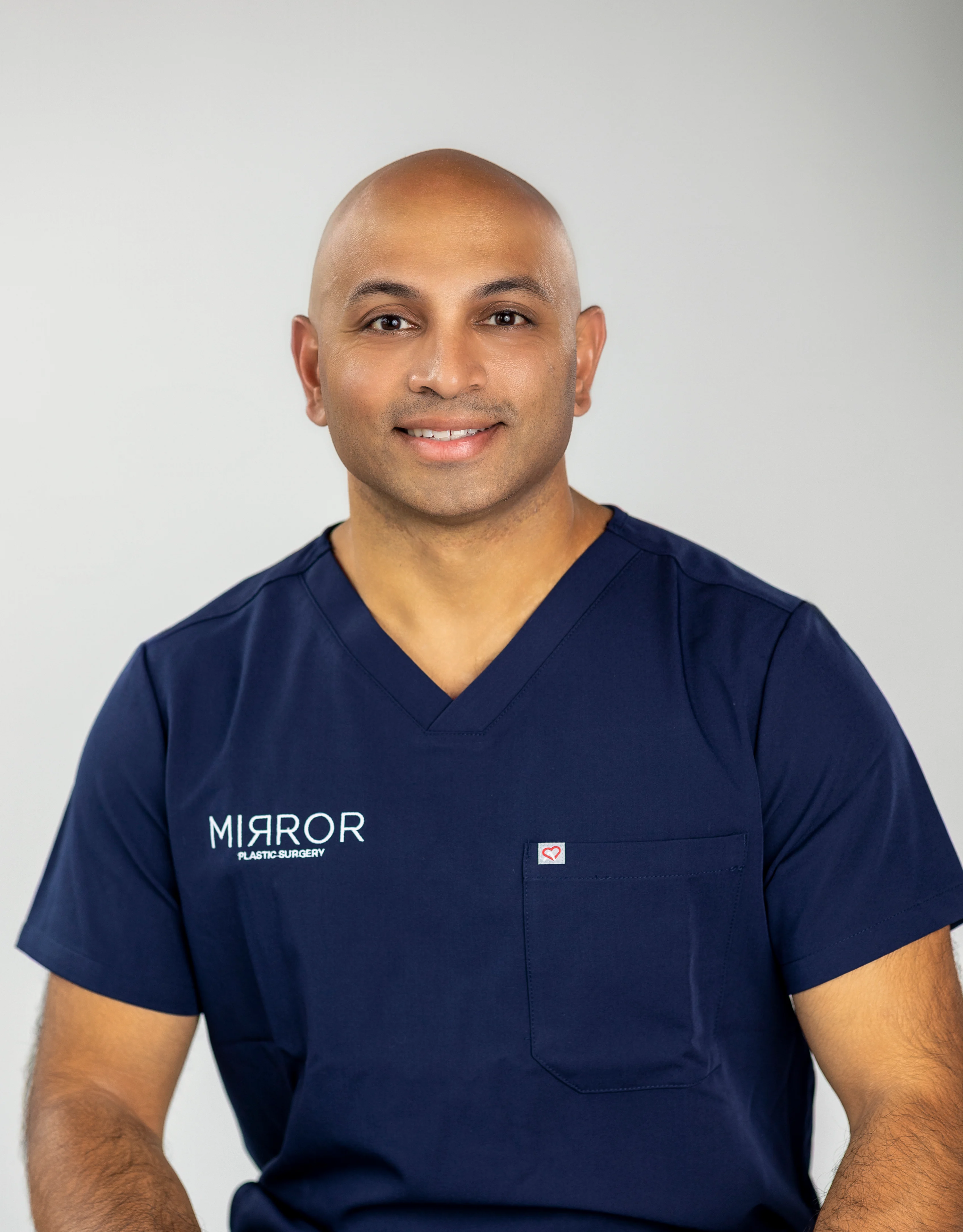
Dr. Akash Chandawarkar, MD, is the founder of Mirror Plastic Surgery and personally performs the practice's injectable and non-surgical treatments, including hair restoration with Acorn Biolabs Secretome and Platelet-Rich Plasma (PRP). He is board certified by the American Board of Plastic Surgery, Harvard-educated, and Johns Hopkins-trained, with fellowship training in aesthetic surgery at Manhattan Eye Ear & Throat Hospital (MEETH)/Lenox Hill Hospital and medical innovation training at Stanford University. He serves as an advisory board member for Merz Aesthetics and Tiger Aesthetics. Because he is a board-certified plastic surgeon, every treatment is placed by a physician with a surgeon's command of anatomy, which supports both safety and precision in hair restoration.
The Three Mechanisms Of Hair Restoration
Every hair restoration strategy works through one or more of three mechanisms. Knowing which mechanism fits your situation helps determine which treatments belong in your plan.
The three mechanisms are:
Slowing Loss: Medications such as minoxidil and finasteride preserve existing follicles by reducing the hormonal signals that cause miniaturization. The American Academy of Dermatology (AAD) states that finasteride can slow hair loss and stimulate new hair growth when taken as directed, and that minoxidil tends to be more effective when used alongside another treatment.
Regrowing Hair: Medications, PRP, and low-level laser therapy can stimulate dormant follicles that retain structural capacity. The AAD notes that a few studies suggest low-level laser therapy may help hereditary hair loss and stimulate healing and hair growth after a hair transplant, though it requires many treatment sessions over many months.
Replacing Hair: FUE and FUT redistribute DHT-resistant follicles from the donor zone into areas of permanent loss. The AAD states that a hair transplant can be an effective and permanent solution for areas of thinning or balding due to male or female pattern baldness.
The table below compares each modality across candidacy, maintenance, and realistic outcomes so you can see how each fits into a sequenced plan.
Modality | Mechanism | Candidacy | Maintenance Requirement | Realistic Outcome |
|---|---|---|---|---|
Minoxidil | Slows loss; stimulates dormant follicles | Most patients with active androgenetic alopecia | Daily, ongoing; stopping use typically reverses the gains it provided | Many patients see some regrowth; results visible at 6–12 months |
Finasteride | Reduces DHT; slows miniaturization | Men with androgenetic alopecia; FDA-approved for male pattern hair loss | Daily pill; must continue to maintain results | Maintains or improves hair counts in approximately 83% of men at two years |
PRP | Stimulates follicular proliferation; supports graft take | Patients with early-to-moderate loss; adjunct to transplant | A typical schedule is monthly sessions for the first three months, then maintenance every three to six months, though many providers recommend intervals ranging from four to twelve months depending on individual response | Increases in hair density of approximately 10–30 hairs/cm² compared to baseline in randomized controlled trials |
Low-Level Laser Therapy | Stimulates cellular energy; reduces perifollicular inflammation | Hereditary hair loss; adjunct option | Several sessions per week for many months | Some patients see thicker, fuller hair; not everyone responds |
FUE | Redistributes DHT-resistant donor follicles | Stable androgenetic alopecia with adequate donor density; FUE accounts for 85.4% of male hair restoration surgical procedures | Medication recommended post-op to protect native hair; 72.3% of surgeons prescribe finasteride before and after transplant | 90–98% graft survival at 12 months at accredited physician-led clinics; full results at 12–18 months |
FUT | Redistributes DHT-resistant donor follicles via strip excision | Patients needing high graft counts; those who can accept a linear scar | Medication recommended post-op; same native-hair management applies | Comparable graft survival to FUE when performed by an experienced surgeon; full results at 12–18 months |
If your loss is early and your follicles are still active, medication and PRP are usually the primary tools. If areas of loss are permanent and your donor supply is adequate, surgical redistribution becomes relevant. Many patients benefit from a thoughtful combination of both.
Who Is A Candidate For Hair Restoration And Who Should Wait
Candidacy for hair transplant surgery depends on pattern stability, donor density, and the type of hair loss. Desire for more hair alone does not determine suitability.
For men, the Hamilton-Norwood classification describes seven progressive stages of male hair loss. Norwood III to IV men with good donor density are generally the strongest surgical candidates. For women, the Ludwig classification describes three stages of female pattern hair loss characterized by progressive central scalp thinning with preservation of the frontal hairline.
Key candidacy benchmarks include:
Pattern Stability: Hair loss must be stable for at least 6 to 12 months before transplant surgery is considered, because operating on active loss creates islands of transplanted hair surrounded by new bald areas.
Miniaturization Thresholds: Donor-zone miniaturization above 35% is an absolute contraindication to hair transplant surgery. Miniaturization exceeding 15% in the recipient area is a warning sign requiring 6 to 12 months of medical therapy before surgery.
Patients who should avoid a transplant for now, or delay it, include those with unstable or rapidly progressing loss, Diffuse Unpatterned Alopecia (DUPA), in which miniaturization affects the entire scalp including the donor zone, insufficient donor supply relative to the coverage goal, active uncontrolled medical conditions, or unrealistic expectations about density or permanence.
Only approximately 2 to 5% of women experiencing hair loss are true surgical candidates, primarily because DUPA is far more common in women. Mayo Clinic and the AAD both emphasize that an accurate diagnosis from a qualified physician is the essential first step before any treatment decision.
The donor supply is finite. The donor zone holds approximately 4,000 to 8,000 grafts across a lifetime. A transplant redistributes what exists and does not create new hair. If you are not yet a candidate, medical stabilization is the right starting point.
Medication And PRP: Building A Foundation That Preserves What You Have
Minoxidil usually takes about 6 to 12 months to show visible results and must be used as directed on an ongoing basis. Finasteride typically takes about 4 months to show improvement and tends to be more effective when begun when hair loss is first noticed. Both require continued use to maintain results, and stopping either reverses the benefit.
PRP concentrates platelet growth factors and injects them into the scalp. These factors stimulate follicular proliferation, increase dermal papilla cell activity, and shift follicles from telogen toward anagen. A typical PRP maintenance schedule for hair restoration is monthly sessions for the first three months, followed by maintenance sessions every three to six months, though many providers adjust intervals based on individual response. PRP works best as an adjunctive therapy that may improve the quality of existing hair and early post-transplant recovery, rather than as a replacement for medical stabilization or surgical planning.
Low-level laser therapy serves as an additional option for some patients. Multiple randomized, double-blind, sham-controlled trials demonstrate significantly greater hair count increases in treated versus sham-device groups, although the effect size is modest and the time commitment is significant.
Medication and PRP help preserve what you have, while transplant redistributes what remains. A sequenced plan that stabilizes first and then considers surgery supports a result that still looks natural at five and ten years.
Start With A Physician-Led Consultation
FUE Vs FUT: How Each Works And Who Each Suits
Both FUE and FUT relocate follicular units from the donor zone to areas of permanent loss. The difference lies in how those follicles are extracted and how the donor area heals.
FUE (Follicular Unit Extraction) uses a small punch device to individually extract follicular units one by one. It leaves small round scars scattered across the donor area, each roughly 0.8 to 1.0 mm, that become essentially invisible once hair regrows around them. FUE now accounts for roughly 80% of hair restoration surgeries globally. It suits patients who prefer shorter hairstyles, want to avoid a linear scar, and have adequate donor density for individual extraction.
FUT (Follicular Unit Transplantation) harvests a strip of occipital scalp under local anesthesia, from which individual follicular unit grafts are dissected under magnification. It leaves a permanent linear scar, usually 1 to 2 mm wide once healed. FUT can yield a higher graft count in a single session and may be appropriate for patients who need extensive coverage and are comfortable with the scar trade-off.
Neither technique works better for every patient. The right choice depends on donor density, desired hairstyle, tolerance for scarring, and the total graft count required. A 2024 BMC Surgery study found over 90% follicle survival in FUE, with more than 85% of patients achieving greater than 95% survival at 12 months. Experienced, physician-led clinics can achieve comparable graft survival with both techniques when they match the method to the patient.
The technique matters less than the physician performing it and the candidacy assessment that comes first.
How Long Hair Transplants Last And What To Expect 10 Years Later
Transplanted hair is typically permanent. Follicles harvested from the lower occipital donor zone are inherently less sensitive to DHT, a property known as donor dominance.
The more important long-term variable is what happens to the native hair surrounding the grafts. Native hair in the frontal and vertex areas retains high DHT sensitivity, so a hair transplant relocates follicles without changing the underlying androgenetic alopecia. Ten years after surgery, the transplanted hair is often still present, while the surrounding native hair may have continued to thin and create a visible contrast.
Public figures whose hair restoration results have been widely discussed, including Elon Musk, Donald Trump, and Matthew McConaughey, illustrate how long-term outcomes vary. Natural, durable results usually pair ongoing medical management with surgical redistribution. Isolated or unnatural results often reflect a transplant performed without a plan for the native hair that continues to thin around it.
A hair transplant addresses existing baldness but does not stop androgenetic alopecia in non-transplanted areas. A sequenced plan that uses medication and PRP to protect native hair and transplant to restore permanently lost areas supports a result that still looks balanced at 10 years.
Is 40 Too Old For A Hair Transplant
Age alone rarely disqualifies a patient from hair transplant surgery. The optimal hair transplant candidacy window is typically 30 to 60 years of age, when loss patterns are most predictable. Patients in their 40s and 50s often have structural advantages such as a fully established loss pattern, the possibility of a single-session solution, and mature expectations.
Younger patients carry more risk because their pattern is still evolving. Men under 25 or with rapid loss in the past 12 months should typically undergo a period of medical therapy before surgery is scheduled. Operating on an unstable pattern risks stranding transplanted follicles ahead of hair that keeps receding behind them.
A patient at 42 with a stable Norwood IV pattern, adequate donor density, and no active medical contraindications is often an excellent candidate. A patient at 28 with a rapidly progressing pattern and a family history of Norwood VII usually needs stabilization and careful long-term planning before surgery.
What matters most is whether your pattern has stabilized and whether your donor supply can support the coverage you need now and in the future.
What To Look Out For And Avoid In Hair Restoration
Several common misconceptions and provider behaviors can steer patients toward poor decisions.
Misconceptions to avoid include:
A Transplant Stops Future Hair Loss. A hair transplant addresses existing baldness but does not stop androgenetic alopecia in non-transplanted areas. Ongoing medical management is required to protect the result.
More Grafts Always Mean A Better Result. Many clinics promote bulk packages as a commercial hook, while the quality of extraction and strategy matters more than the number alone. Overharvesting depletes the finite donor supply and can create a moth-eaten appearance.
Any Provider Can Safely Perform The Procedure. In the United States, any licensed physician can legally perform hair transplant surgery without specialized training in hair restoration. Repair cases rose from 6% in 2021 to 10% in 2024, largely driven by unqualified providers.
Warning signs of a questionable provider include pressure to book from the first call without clinical evaluation, consultations run by commercial advisors rather than physicians, refusal to show real clinical cases with documented graft counts and timelines, and no follow-up plan after the procedure.
Mirror Plastic Surgery uses a physician-led consultation, honest candidacy assessment, evidence-based treatment planning, and dedicated support before, during, and after every procedure.
Get Your Personalized Restoration Plan
Frequently Asked Questions
What Is The Best Method Of Hair Restoration
No single method works best for every patient. The right approach depends on your pattern of loss, donor supply, and whether your loss is still active. Earlier sections outline how medication, PRP, laser therapy, and surgical options fit together in a typical sequence.
For many patients, the most effective plan combines medication and PRP to preserve existing hair with surgery to restore areas of permanent loss, introduced in that order.
How Long Do Hair Transplants Usually Last
Transplanted hair usually lasts for life because it comes from the DHT-resistant donor zone and keeps that resistance after relocation. As covered above, the main long-term change comes from native hair thinning around the grafts. Protecting non-transplanted hair with ongoing medication supports a more stable appearance over time.
Is It Actually Possible To Regrow Lost Hair
Regrowth depends on the stage of loss. Follicles in early and middle stages of androgenetic alopecia retain structural capacity and can respond when the DHT stimulus decreases. Minoxidil and finasteride can stimulate regrowth in dormant follicles, and PRP can support that process. In advanced disease, where follicles have been inactive for years and replaced by fibrous tissue, medication alone rarely restores density, so surgical redistribution becomes the primary option. Early diagnosis and treatment keep more options open.
What Happens 10 Years After A Hair Transplant
As discussed earlier, transplanted follicles usually keep growing at 10 years because they retain donor-zone DHT resistance. Visible change at that point often reflects thinning of native hair around or behind the transplanted area. Patients who maintain medication after surgery, as most experienced surgeons recommend, tend to preserve a more natural, blended result.
Which Hair Transplant Clinic In The US Is Considered The Best
No single clinic holds a universal designation as the best in the United States. Helpful criteria include board certification in plastic surgery or hair restoration surgery, a physician-led consultation process, transparent candidacy assessment, documented before-and-after cases with graft counts and timelines, and a clear post-operative follow-up plan. Practices that limit daily surgical volume, perform comprehensive pre-operative evaluations, and provide ongoing medical management after surgery consistently produce stronger long-term outcomes than high-volume clinics that prioritize throughput. In the Tampa Bay area, Mirror Plastic Surgery offers physician-led hair restoration with the anatomical expertise and concierge approach that these criteria describe.
Book A Consultation With Dr. Akash Chandawarkar
Dr. Akash Chandawarkar is currently welcoming new patients at Mirror Plastic Surgery in St. Petersburg, Florida. Consultations run up to an hour and include a comprehensive top-to-bottom assessment. You leave with an honest understanding of your candidacy, your options, and what a sequenced plan looks like for your specific pattern of loss.
Patients can text or call to secure an appointment:
Phone: 727-361-6515
Email: [email protected]
Address: 780 4th Ave S, St. Petersburg, FL 33701
Reserve Your Consultation With Dr. Chandawarkar
Your Personalized Hair Restoration Plan
Every person's pattern of loss, donor supply, and long-term goals is different. No universal protocol fits every patient. A comprehensive physician-led assessment is the only reliable way to determine which mechanisms apply to your situation, which treatments belong in your plan, and in what sequence they should be introduced.
The goal of that assessment is to recommend the right procedures in the right order, with clear expectations about what each can and cannot do.
Disclaimer: Results may vary from person to person. Editorial content, before and after images, and patient testimonials do not constitute a guarantee of specific results.