
Written by: Dr. Akash Chandawarkar, Board Certified Plastic Surgeon, Mirror Plastic Surgery | Last updated: October 1, 2026
Key Takeaways
- Laser skin tightening is a non-surgical treatment that uses controlled heat to stimulate collagen, improving mild to moderate skin laxity.
- Results are real but modest. Non-ablative fractional lasers produce roughly 20% improvement, while ablative fractional CO2 can reach about 57% tightening, which remains below surgical lift outcomes.1
- Outcomes develop gradually over three to twelve months as collagen remodels. Results fade over time because new collagen ages like natural tissue.1
- Device selection, settings, and patient candidacy shape results more than marketing claims. Darker skin tones require specific safety protocols to reduce post-inflammatory hyperpigmentation risk.
- Mirror Plastic Surgery provides these treatments under the direct care of board-certified plastic surgeon Dr. Akash Chandawarkar, with anatomy-driven planning and safety-first protocols.
Schedule Your Laser Tightening Consultation
Key Concepts and Terminology
Laser skin tightening works by delivering controlled heat to the dermis, which contracts existing collagen and triggers new collagen production over time. A 2026 scoping review published in JDDG describes the non-ablative fractional laser tissue response as a triphasic process: an inflammatory phase, a proliferative phase beginning within 24 hours, and a prolonged remodeling phase from weeks two through twelve marked by collagen and elastin fiber synthesis. Device categories differ in how they deliver heat, how deep it reaches, and what happens to the skin surface.
The three primary laser categories for skin tightening are:
- Ablative Lasers – These devices vaporize the outer skin layers in a controlled pattern, removing surface tissue while heating the dermis beneath. Fully ablative CO2 laser removes 100% of the skin surface in the treated area, producing dramatic collagen contraction and new collagen production over six to twelve months, with initial healing requiring ten to fourteen days.1 Results are among the most durable non-surgical options, with higher risk and longer recovery.
- Non-Ablative Lasers – These devices heat tissue beneath an intact or mostly intact epidermis. Non-ablative laser results are generally less dramatic than ablative resurfacing, with a smaller magnitude of tightening but lower downtime and risk.1 Common wavelengths include 1,320 nm, 1,440 nm, 1,550 nm, and 1,565 nm, with 1,550 nm erbium-glass as a well-known example.
- Fractional Lasers – Fractional delivery treats microscopic columns of skin called microthermal zones (MTZs) while leaving surrounding tissue intact to support faster recovery. Fractional delivery remains a major driver of the laser resurfacing market because it balances efficacy with faster healing by treating microscopic thermal zones while preserving surrounding tissue for re-epithelialization. Fractional technology can be applied to both ablative and non-ablative platforms, creating a range of outcomes and downtime profiles.
Within these categories, treatment depth is determined by a combination of wavelength, pulse duration, fluence, fractional density, spot size, number of passes, and cooling. No single parameter controls depth. For a 1,550 nm non-ablative fractional laser, MTZ depth increases from roughly 280–400 µm at 5–6 mJ to roughly 1,300–1,359 µm at 60–70 mJ, showing that pulse energy directly determines how deep the laser’s thermal effect reaches into the dermis.
Ask Which Laser Category Fits Your Skin
Do Skin Tightening Lasers Really Work?
Laser skin tightening produces real but modest improvement when matched to the right patient and the right device. The answer comes from separating what clinical evidence shows from what marketing suggests. Five points matter most.
- The Magnitude of Effect Is Real but Below Surgical Results. Research by Tierney and Hanke in the Journal of Clinical and Aesthetic Dermatology found that fractional CO2 laser treatment produced a 57% mean improvement in skin tightening on the lower face and neck.1 Non-ablative fractional devices create more modest gains. A 2026 split-face study reported that a 1,565 nm non-ablative fractional laser produced a mean 21.69% improvement in scar severity scores, which reflects measurable but modest tissue remodeling of roughly one-fifth improvement.1
- Results Develop Over Months, Not Days. Visible improvement from laser skin tightening may begin within several weeks and continue for three to six months or longer, with immediate appearance offering little insight into the final result.1 Collagen remodeling follows a biological timeline rather than an instant transformation.
- Device Selection and Settings Shape Outcomes. Skin tightening treatments underperform when dermal temperature never reaches the collagen denaturation threshold, when the device does not match the type of laxity, or when results are judged before the three to four month remodeling window ends.
- Candidacy Matters More Than Brand Name. Laser tightening works best when skin quality contributes meaningfully to the concern and works less well when major volume loss, prominent fat pads, muscle activity, bone structure, or substantial excess skin dominate the picture.
- Results Fade Over Time. The new collagen built during treatment ages on the same timeline as the original collagen, so results soften with ongoing aging and environmental exposure. Sun protection, smoking avoidance, and consistent skincare extend the benefit.
Find Out What Results You Can Realistically Expect
What Is the Strongest Skin Tightening Procedure?
The strongest approach depends on the severity and type of laxity rather than a single superior device. The correct hierarchy is matched to each patient’s anatomy.
For mild laxity with a meaningful skin quality component, non-ablative fractional laser is a logical first-line option. It supports collagen remodeling with limited downtime and suits patients who care about texture, tone, and fine lines as much as firmness.
For mild to moderate laxity where structural tightening is the main goal, radiofrequency, particularly monopolar or RF microneedling platforms, reaches deeper tissue planes and often produces more consistent tightening than non-ablative laser alone. Mirror Plastic Surgery’s guide to radiofrequency skin tightening explains the mechanism, outcomes, and candidacy for RF in detail.
For moderate laxity where structural lift is the goal, microfocused ultrasound (HIFU) is the only non-surgical technology that reaches the SMAS layer at 4.5 mm depth, the same fibromuscular layer addressed during a facelift. Microfocused ultrasound is positioned as “lifting” rather than “tightening” because it targets the structural layer surgeons address during a facelift.
For defined sagging that needs repositioning, thread lifts provide immediate mechanical lift. Visible lifting effects typically last about six to eighteen months, and threads suit mild to moderate laxity while leaving significant excess skin to surgical repositioning.
For significant laxity such as jowls hanging below the jawline, deep platysmal bands, or large folds of excess skin, energy devices do not deliver satisfying results. Patients with large folds of loose skin, hanging skin after major weight loss or pregnancy, or rashes in skin folds benefit more from a plastic-surgery consultation than from non-surgical tightening, because device treatments cannot remove large amounts of excess skin. Dr. Akash explains this clearly during consultation when it applies.
Discuss the Right Level of Tightening or Lift for You
Laser Skin Tightening vs Radiofrequency vs Ultrasound
Laser, radiofrequency, and microfocused ultrasound often appear side by side in marketing, yet they work through different mechanisms, reach different depths, and suit different laxity patterns. The table below compares them on mechanism and depth, typical session count, and the laxity profile each modality serves best.
For patients comparing laser and RF, laser often serves best when skin quality issues such as texture, tone, pigmentation, and fine lines matter as much as firmness. RF often serves best when the primary goal is structural tightening with minimal downtime and broad safety across skin tones, because radiofrequency targets tissue resistance rather than melanin. Radiofrequency is generally safe across all skin tones because it does not target melanin, although a small risk of temporary pigment change exists in darker skin and complications can occur with aggressive settings.
Compare Laser, RF, and Ultrasound for Your Skin
Laser Skin Tightening for the Neck and Jawline
The neck and jawline are among the most requested and technically demanding areas for laser skin tightening. Early jowling, crepey neck skin, and horizontal neck lines each have distinct anatomical drivers, and laser addresses some more effectively than others.
For early jowling, which reflects subtle softening of jawline definition before clear descent, laser skin tightening can improve skin quality and create modest collagen-driven tightening. It does not reposition tissue that has already descended. A softened jawline can reflect skin laxity, lower-face volume shifts, submental fullness, or a combination of these factors. Heating the skin addresses only the laxity component. When early jowling is primarily a skin quality issue, non-ablative fractional laser is a reasonable choice. When true tissue descent dominates, radiofrequency, ultrasound, or a surgical consultation offers a more appropriate path.
For crepey neck skin, laser can meaningfully improve texture and stimulate collagen in the superficial dermis. The neck requires particular caution. The neck may heal differently from the face. It has fewer pilosebaceous units to assist re-epithelialization, which increases vulnerability to overly aggressive resurfacing. The same laser settings should not be applied uniformly to every region.
For horizontal neck lines, often called necklace lines, laser tightening can soften their appearance by improving skin quality and elasticity. Deep, established lines driven by repetitive movement respond better to a combination approach. Mirror’s guide to neck tightening at the med spa outlines the full range of non-surgical options for this area.
Find Out Whether Your Jawline Needs Tightening or Lifting
Laser Skin Tightening for the Stomach and Body
Laser skin tightening can also treat body areas such as the stomach, inner arms, and thighs, although results are more limited than on the face. Honest candidacy assessment becomes even more important for these thicker, more stretched tissues.
For mild post-pregnancy or post-weight-loss laxity on the abdomen, laser skin tightening can modestly improve skin quality and firmness. Abdominal skin, which is thicker and more prone to stretch-mark-type changes, may require three to four sessions, with initial tightness appearing at three to four weeks and optimal firmness around three months. Improvement is real yet proportionally smaller than on facial skin, which responds more readily to collagen stimulation.
For significant post-pregnancy or post-major-weight-loss laxity, such as loose folds, hanging skin, or extensive stretch marks, laser skin tightening does not address the core problem. According to the American Board of Cosmetic Surgery, non-surgical skin tightening can modestly improve mild to moderate loose skin but cannot remove excess skin, so severe laxity often still requires surgical evaluation. A tummy tuck or body lift treats the structural excess that energy devices cannot remove.
For the inner arms, laser tightening can improve skin quality and create modest firming in patients with mild laxity. Patients with significant hanging skin in this area benefit more from a surgical arm lift consultation.
Ask If Your Body Concerns Suit Laser or Surgery
Laser Skin Tightening Before and After: Setting Realistic Expectations
“Before and after” photos signal high intent, so they deserve context rather than a highlight reel of best cases. The visible timeline after laser skin tightening follows a predictable biological sequence.
A typical results timeline includes slight firmness immediately after treatment from collagen contraction, early collagen production at four to six weeks, visible tightening and improved texture at three to six months, and peak results at six to twelve months.1 The immediate firmness reflects acute collagen contraction rather than the slower process of new collagen synthesis.
The difference between early contraction and later remodeling shapes expectations. Patients who judge results at two weeks are evaluating a process that continues for months. Procollagen I protein levels in the dermis peak at weeks three and four after non-ablative fractional laser treatment, with gene expression of key collagen subtypes upregulated from the second through fourth week. The visible improvement that patients photograph and share usually reflects the remodeling phase, not the immediate post-treatment appearance.
Durability depends on treatment depth and post-treatment care. Non-ablative laser resurfacing results generally last one to two years, while deep ablative resurfacing can last five to ten years or longer, with durability influenced by sun exposure, skincare, and the rate of ongoing collagen loss.1 Maintenance sessions extend the benefit rather than restarting the process.
Review Expected Before and After Changes for Your Case
Laser Skin Tightening for Darker Skin Tones: Risks and Safety
Laser skin tightening can be performed safely on darker skin tones when device choice, settings, and protocols are tailored to melanin-rich skin. The consequences of incorrect choices can be serious, so this topic deserves explicit attention.
The core risk is post-inflammatory hyperpigmentation (PIH). In darker skin tones (Fitzpatrick IV–VI), inflammation from aesthetic procedures can activate melanocytes that produce larger and more numerous melanosomes, creating visible darkening that can take months to years to resolve. A secondary risk is hypopigmentation, which appears as permanent pale patches caused by melanocyte damage from overly aggressive resurfacing. Over-aggressive laser treatment on darker skin can damage melanocytes and cause hypopigmentation, which is generally harder to correct than post-inflammatory hyperpigmentation.
For higher Fitzpatrick types, device selection functions as a safety decision. For Fitzpatrick V–VI patients, the recommended resurfacing approach uses non-ablative fractional laser at 1,550 or 1,927 nm at low density, while avoiding ablative lasers when possible. Fully ablative CO2 laser is most commonly recommended for Fitzpatrick skin types I to III, and patients with darker or olive skin tones face a significantly higher risk of post-inflammatory hyperpigmentation after fully ablative CO2 compared with fractional CO2.1
Settings adjustments for darker skin follow clear evidence. For Fitzpatrick IV–VI, treatment settings should be cautiously adjusted to minimize epidermal thermal injury and PIH risk, including reducing energy by 20–30%, decreasing coverage, extending treatment intervals by one to two weeks, and reducing needle length and power.
Pre-treatment preparation lowers risk further. A pre-treatment PIH prevention protocol should start at least two weeks before laser treatment. It includes strict daily SPF 50+, no tanning, and a topical melanogenesis inhibitor such as 4% hydroquinone, started two weeks before treatment and continued three to four weeks afterward under dermatologist supervision.
Mirror Plastic Surgery’s approach to laser hair removal across skin tones, including a Fitzpatrick-specific safety framework, appears in the practice’s physician’s guide to laser hair removal for all skin tones. The same safety-first principles apply to laser skin tightening across the full Fitzpatrick spectrum.
Get a Fitzpatrick-Specific Safety Assessment
Important Considerations Before Choosing Laser Skin Tightening
Several high-level factors should guide any decision about laser skin tightening, regardless of device brand or provider.
Candidacy Is the Central Variable. Laser skin tightening works best in patients with mild to moderate laxity, good baseline skin quality, realistic expectations, and no contraindications. That last point explains why screening matters more than device choice. Active skin infection in the treatment area, pregnancy, recent isotretinoin use, a personal history of keloid scarring, and certain photosensitizing medications all increase the risk of poor outcomes. When any of these factors are present, treatment is commonly postponed during pregnancy, active infection, an open wound, a significant inflammatory flare, or recent substantial sun exposure. Treatment resumes when risk decreases.
Number of Sessions Varies By Modality and Concern. Non-ablative fractional lasers typically require three to five sessions to reach optimal results. Ablative fractional CO2 often delivers meaningful change in one to two sessions at the cost of more downtime. The right number for a given patient depends on baseline laxity, device choice, and recovery tolerance.
Long-Term Maintenance Keeps Results on Track. “Permanent skin tightening” claims are usually misleading because a treatment may create a lasting tissue change yet cannot stop future collagen loss or laxity from aging, sun exposure, smoking, or weight change. Maintenance sessions on an annual or semi-annual basis provide a realistic framework for sustaining results.
A Personalized Plan Outperforms a Standard Package. Each patient’s anatomy, skin tone, laxity pattern, and goals differ. At Mirror Plastic Surgery, every patient receives a personalized treatment plan and quote during consultation based on their specific situation rather than a uniform menu price.
Plan a Personalized Laser Tightening Strategy
What Sets Mirror Plastic Surgery Apart
Mirror Plastic Surgery follows a concierge model that differs from high-volume aesthetic clinics. Each new patient receives a top-to-bottom assessment that can last up to an hour. This time allows for a clear understanding of the anatomical drivers of concern, long-term goals, and the emotional context behind seeking treatment. The practice limits itself to one to two surgeries per day so the clinical team can focus fully on each patient before, during, and after every procedure.
The guiding clinical hierarchy at Mirror is safety first, function second, and aesthetics third. That sequence shapes how treatment plans are constructed and how honest the conversation remains when a patient’s concern is better addressed by a different modality or by no procedure at all.
Non-surgical energy-based treatments, including laser skin tightening, are led directly by Dr. Akash Chandawarkar. As a board-certified plastic surgeon, he plans and delivers every treatment with a surgeon’s command of facial and subdermal anatomy, which supports both safety and precise targeting.
Experience Mirror’s Safety-First, Concierge Approach
Meet Your Provider: Dr. Akash Chandawarkar
Dr. Akash Chandawarkar, MD, founded Mirror Plastic Surgery and personally performs the practice’s non-surgical and surgical procedures. He is Harvard-educated and completed plastic surgery training at Johns Hopkins, one of the most rigorous programs in the field. He then completed an aesthetic surgery fellowship at the Manhattan Eye Ear & Throat Hospital (MEETH) / Lenox Hill Hospital in New York City and pursued medical innovation training at Stanford University. He is board certified by the American Board of Plastic Surgery.
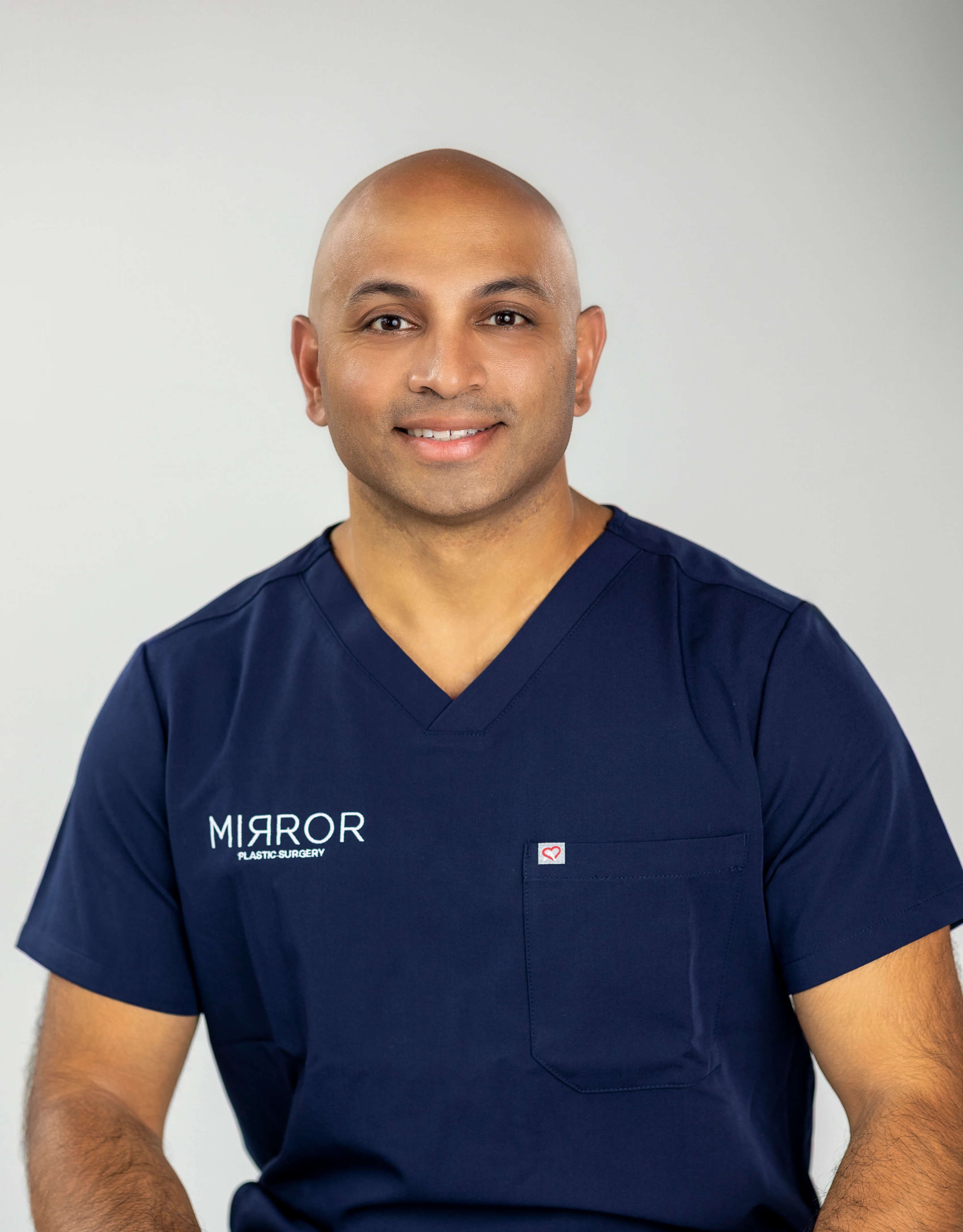
Dr. Akash serves on the advisory boards of Merz Aesthetics and Tiger Aesthetics, which keeps him closely connected to device and product development. His approach remains supplier-neutral. Treatment recommendations rest on evidence and patient anatomy rather than device contracts or product quotas. He is known for telling patients when an expensive service is not yet necessary, a level of transparency that supports long-term trust.
That transparency starts with shared language and realistic expectations. To evaluate what any provider is offering, patients benefit from understanding how devices are categorized and what each category can achieve.
Meet with Dr. Akash to Review Your Options
Common Misconceptions and Challenges
Several persistent misunderstandings about laser skin tightening cause patients to overestimate results or underestimate what treatment requires.
Expecting Surgical-Lift Results from a Non-Surgical Device. Laser skin tightening cannot replace a facelift when substantial sagging or excess tissue is present; lasers improve skin quality and may create modest tightening through collagen remodeling but do not reposition deeper facial tissues or surgically remove redundant skin. Patients whose main concern is significant tissue descent will not feel satisfied with energy-based treatment alone.
Assuming One Session Is Enough. Non-ablative fractional laser typically requires a series of sessions for meaningful results. Even ablative treatments, which can produce significant change in a single session, continue to improve for six to twelve months as collagen remodeling progresses. Judging results after one session and one month happens too early.
Underestimating Downtime for Ablative and Fractional Treatments. Downtime after a laser treatment ranges from none for superficial non-ablative passes to roughly seven to ten days for deep ablative fractional resurfacing. Providers who describe all laser treatments as “no downtime” usually offer only superficial non-ablative passes or use imprecise language.
Equating “More Aggressive” with “Better.” More redness or peeling does not guarantee better outcomes, and overly aggressive settings increase risk without improving results.
*Disclaimer: Results may vary from person to person. Editorial content, before and after images, and patient testimonials do not constitute a guarantee of specific results.
1 Results may vary from person to person. Editorial content, before and after images, and patient testimonials do not constitute a guarantee of specific results.