
Written by: Dr. Akash Chandawarkar, Board Certified Plastic Surgeon, Mirror Plastic Surgery
Key Takeaways
- Primary rhinoplasty is performed on an untouched nose, while revision rhinoplasty is reconstructive surgery on a nose already altered by scar tissue, depleted cartilage, and structural changes.
- Revision rhinoplasty is more complex, requires longer recovery, and often needs cartilage grafts from the ear or rib because septal cartilage is frequently unavailable.
- Patients must wait at least 12 months, and often 18 months, after primary rhinoplasty before considering revision so swelling can resolve and the final result can emerge.
- Secondary procedures carry a higher revision risk than primary ones, though rates vary widely by surgeon and patient population; success depends on choosing a surgeon with specific revision experience and a safety-first, function-second, aesthetics-third approach.1
- Mirror Plastic Surgery provides personalized revision rhinoplasty consultations with Dr. Akash, focusing on structural integrity and realistic outcomes.
Book a consultation with Dr. Akash at Mirror Plastic Surgery
How Careful Practices Approach Rhinoplasty and Revision Rhinoplasty
High-quality rhinoplasty care begins with a thorough in-person evaluation. That evaluation assesses the patient’s anatomy, prior surgical history, functional airway status, and aesthetic goals before any operative plan is discussed. Evidence-based planning follows, grounded in a clear hierarchy: safety first, function second, aesthetics third. That sequence reflects the clinical reality that a nose which breathes poorly or carries structural risk cannot be made beautiful in any durable sense.
Revision planning in particular requires clarity about the original anatomy, the prior surgical technique, and the structural deficits that now exist before any aesthetic goal enters the conversation. Some of the previous surgeon’s work can only be fully understood once the nose is opened, so the revision surgeon must be ready to adapt the plan during surgery. Because that kind of intraoperative adaptability demands sustained attention, careful practices limit surgical volume, performing one to two procedures per day rather than five to ten, so the entire clinical team’s attention remains on each patient before, during, and after the procedure.
Book a consultation with Dr. Akash
A Surgeon’s Perspective On Revision Rhinoplasty
Dr. Akash is the lead surgeon at Mirror Plastic Surgery in St. Petersburg, Florida. He earned his M.D. cum laude with Honors in a Special Field from Harvard Medical School through the Harvard-MIT Division of Health Sciences and Technology. He completed a seven-year integrated plastic and reconstructive surgery residency at Johns Hopkins, then trained in aesthetic surgery at the Manhattan Eye, Ear and Throat Hospital (MEETH), one of the most competitive aesthetic fellowship programs in the country. He is certified by the American Board of Plastic Surgery.
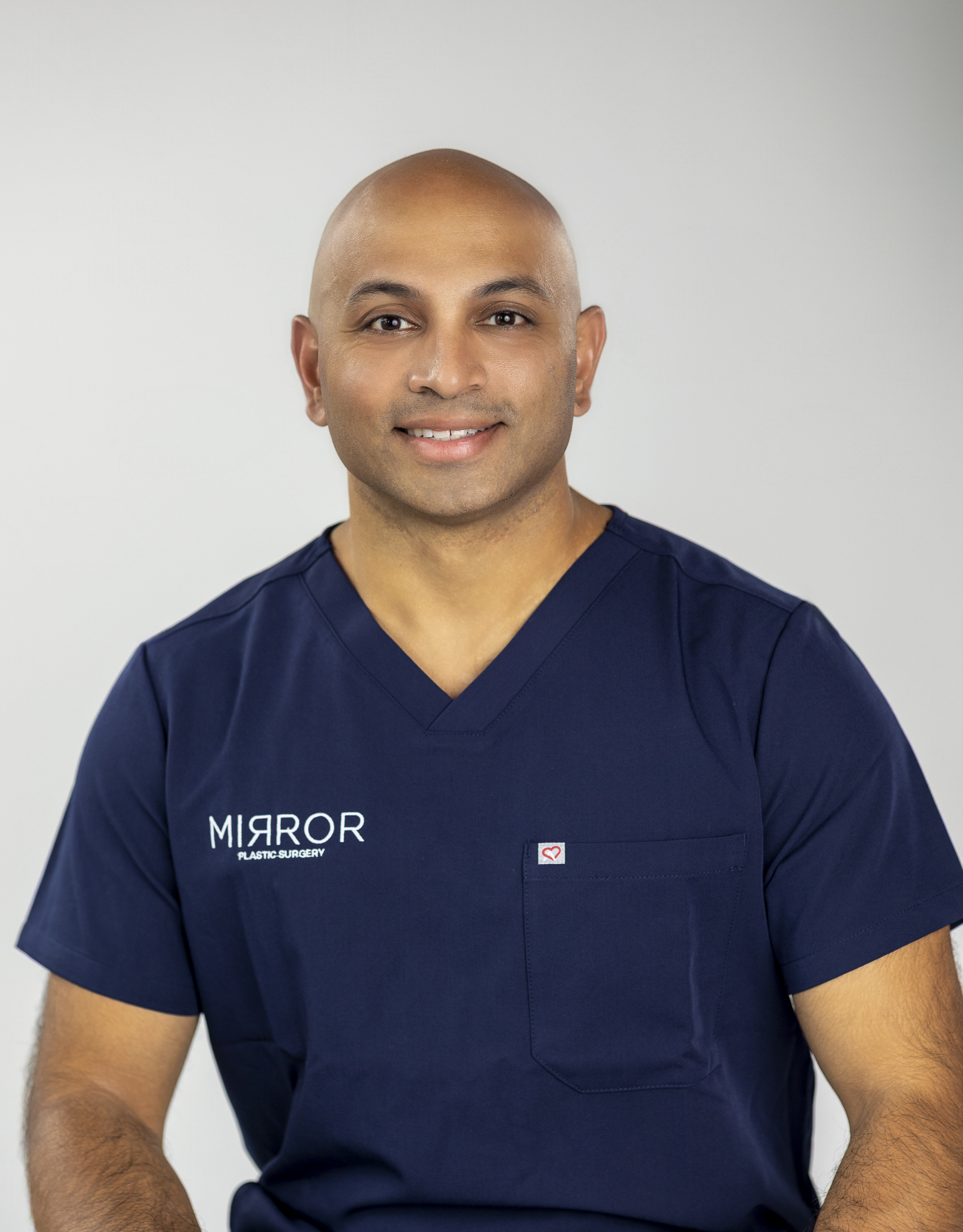
Dr. Akash serves as Next Generation Editor for Aesthetic Surgery Journal, has testified before the U.S. Food and Drug Administration on breast implant safety, and has published peer-reviewed research on the application of artificial intelligence and machine learning for objective analysis in aesthetic surgery, with a particular focus on rhinoplasty. He has presented this work at The Rhinoplasty Society Annual Meeting. Newsweek has named him in America’s Best Plastic Surgeons 2025 for two consecutive years.
His approach to rhinoplasty, both primary and revision, follows the same hierarchy that governs every procedure at Mirror Plastic Surgery: safety, then function, then aesthetics. In revision cases, that order matters even more because the structural foundation of the nose has already been altered once.
Key Terms You Need Before Comparing Primary and Revision Rhinoplasty
With that context in mind, it helps to define the terms that recur throughout any serious discussion of primary vs revision rhinoplasty. Understanding them from the ground up prevents confusion when evaluating surgical plans or reading operative notes.
Primary rhinoplasty is nasal surgery performed on a nose with no prior surgical history. The anatomy is untouched, tissue planes are clear, and cartilage reserves are intact.
Revision rhinoplasty is nasal surgery performed on a nose that has already been operated on at least once. The anatomy has been altered, scar tissue is present, and cartilage may be depleted or repositioned.
Reconstructive rhinoplasty refers to revision surgery that goes beyond refinement. It involves rebuilding structural elements of the nose that have been weakened, collapsed, or removed. Many revisions fall into this reconstructive category.
Minor revision vs full reconstructive revision: A minor revision addresses a limited concern, such as a small contour irregularity or subtle asymmetry, using existing tissue with minimal grafting. A full reconstructive revision rebuilds the nasal framework using cartilage grafts, often from secondary donor sites, and addresses structural collapse, over-resection, or significant functional compromise.
Septoplasty is surgery performed to straighten a deviated nasal septum, primarily to improve breathing. A septoplasty performed for functional reasons counts as prior nasal surgery. It changes the cartilage landscape available for any later rhinoplasty, because septal cartilage used or removed during septoplasty is no longer available as a graft source.
Septal cartilage is the primary cartilage source in primary rhinoplasty. It is strong, straight, and harvested from within the nose without a separate incision. In many revision cases, it is depleted or absent.
Conchal (ear) cartilage is harvested from the bowl of the ear. It is softer and more curved than septal cartilage, making it useful for tip contouring and smaller structural refinements. It is limited in volume and less suited to major structural reconstruction.
Costal (rib) cartilage is harvested from the chest wall. It is abundant and strong, making it the preferred graft source for major revision rhinoplasty requiring significant structural rebuilding. Rib cartilage remains the gold standard for major revision rhinoplasty requiring extensive structural reconstruction, though it carries its own donor-site recovery implications.
Scar tissue forms at every point where nasal tissue is incised, sutured, or grafted. In a previously operated nose, the layers of skin, fascia, and cartilage can fuse together with fibrous scar tissue, making dissection much more delicate and time-consuming than in a primary rhinoplasty where the surgeon works with untouched tissue and clear anatomical planes.
Dorsal framework refers to the structural support of the nasal bridge, the combination of bone and cartilage that gives the nose its profile. Over-resection of the dorsal framework is one of the most common reasons revision rhinoplasty becomes necessary.
Book a consultation with Dr. Akash
How Revision Rhinoplasty Is Understood Today
With those terms defined, it is easier to see how revision rhinoplasty is understood in the field. Surgeons view it as a reconstructive procedure planned around structural integrity and airway function. The clinical consensus, reflected across surgical literature and specialty society guidelines, is that revision surgery addresses a nose whose anatomy has already been permanently altered, and that the planning process must account for what remains rather than what was originally there.
The American Academy of Otolaryngology clinical practice guideline recommends that clinicians document patient satisfaction with both appearance and breathing at a minimum of twelve months after rhinoplasty. That standard reflects the widely accepted principle that the final result of nasal surgery cannot be meaningfully assessed before that point. Most surgeons advise waiting at least 12 months after a primary rhinoplasty before evaluating a revision, because scar tissue collagen maturation continues for 12 to 18 months, during which the initially stiff, poorly organized collagen remodels and softens so that contours refined at surgery become visible through the overlying skin.
Revision rates vary by surgeon, technique, and patient population and should not be read as a universal benchmark. A population study of 175,842 septorhinoplasty patients tracked through three state databases for at least three years found revision rates of 3.1% after a primary operation and 11.0% after a secondary operation.1 A JAMA Facial Plastic Surgery analysis of the same dataset found that roughly 8% of cosmetic rhinoplasties require revision.1 These figures reflect population-level patterns and differ meaningfully by surgeon volume and patient selection.
Book a consultation with Dr. Akash
The Main Decision Factors: Primary vs Revision Rhinoplasty
Those population-level figures matter less than the individual factors that determine whether a patient is a candidate for revision rhinoplasty, and what kind of revision is appropriate.
The 12-month healing window. The most consistent guidance across surgical literature and specialty societies is to wait at least 12 months, and sometimes 18 months, before assessing whether a revision is warranted. Approximately 70–80% of final rhinoplasty swelling has resolved by the end of month six, with the most noticeable ongoing improvement in tip definition and supratip contour occurring between months 3 and 6.1 The tip is the last area to declare itself, particularly in patients with thicker skin. Operating before the 12-to-18-month window risks correcting a problem that would have resolved on its own, missing a problem that only becomes apparent after further settling, and adding scar tissue and reduced cartilage availability to a result that was actually trending in the right direction.
Why revision rhinoplasty is harder. In a previously operated nose, normal anatomical landmarks may be absent, cartilage reserves may be depleted, blood supply may be compromised, and extensive scar tissue may obscure critical structures. Scar tissue behaves differently from native tissue. It alters the planes a surgeon uses to navigate the nose, makes dissection less predictable, and changes how tissue responds to reshaping. When septal cartilage has been used or removed in the primary procedure, the revision surgeon must source graft material from the ear or rib, each of which carries its own technical requirements and donor-site recovery.
Recovery differences. Revision rhinoplasty swelling and tenderness typically last longer than after a primary procedure. Noticeable swelling in revision rhinoplasty cases often persists for 3–6 months, compared to 2–3 weeks in primary rhinoplasty, and final results can take up to 24 months to fully materialize because scar tissue from the previous surgery changes how the tissue heals.1
Self-assessment: Is the result still healing, or is it a revision case? The clearest clinical test is direction of change. Healing trends better week on week, while a real problem trends worse or plateaus badly. Documenting the nose with standardized photographs, using the same lighting and angles (front, both lateral profiles, both three-quarter views) at monthly intervals, provides a reliable record of whether the result is improving, stable, or worsening. Signs that warrant a consultation rather than continued waiting include:
- Persistent breathing difficulty on one or both sides that does not improve after the first year
- Structural asymmetry of the bony pyramid that does not improve through months 6 to 12
- Visible signs of over-resection, such as a scooped or collapsed dorsal profile or a pinched tip
- Pollybeak deformity, meaning fullness in the supratip area, that persists past the one-year mark
- A persistent dorsal deviation not present before surgery
- Collapse of the nasal structure with visible weakness or loss of support in the bridge or tip
Discomfort with the result in the first one to three months, without any of the above structural signs, generally falls within the range of normal post-operative experience and does not by itself indicate a revision case.
Book a consultation with Dr. Akash
Options, Variations, and Approaches in Revision Rhinoplasty
Comparison Of Rhinoplasty Approaches
The table below compares the three approaches across the factors that most affect planning: the structural starting point, the graft material typically required, and how predictable the outcome tends to be.
| Approach | Structural Starting Point | Typical Graft Requirement | Predictability Of Outcome |
|---|---|---|---|
| Primary Rhinoplasty | Untouched anatomy with clear tissue planes and intact cartilage reserves | Septal cartilage often sufficient, ear or rib grafts less commonly required | Higher, with surgical success rates reported above 90% in primary cases1 |
| Minor Revision Rhinoplasty | Previously operated anatomy with scar tissue and a limited structural deficit | Septal or ear cartilage often sufficient when available, limited grafting needed | Moderate, with surgical success rates for revision reported at 75–85%1 |
| Full Reconstructive Revision Rhinoplasty | Significantly altered anatomy with depleted cartilage, compromised blood supply, and extensive scar tissue | Rib cartilage frequently required for major structural rebuilding, ear cartilage as an adjunct | Lower than primary because higher complexity, asymmetric healing, and limited cartilage reduce predictability |
Open vs. closed technique in revision. Most revision rhinoplasty is performed using the open (external) approach, which provides direct visualization of the nasal framework. That visibility becomes essential when scar tissue has distorted anatomy and grafts must be placed with precision. The open vs. closed rhinoplasty distinction matters more in revision cases than in primary ones because the visibility tradeoff of a closed approach becomes more consequential in a scarred surgical field.
Returning to the primary surgeon vs. seeking a revision specialist. Returning to the original surgeon can be appropriate when the concern is minor, the surgeon has revision-specific experience, and the patient retains confidence in the provider. A revision specialist is warranted in several situations. The most common is a structural deficit that requires reconstructive grafting beyond the original surgeon’s routine practice. Other reasons include a primary surgeon who does not regularly perform revision cases or lacks experience with rib cartilage harvesting, a patient who has genuinely lost confidence in the provider, or a second opinion from a board-certified surgeon indicating the original approach was inappropriate for the anatomy.
Questions to ask any surgeon being evaluated for revision work include:
- What percentage of your rhinoplasty practice involves revision cases?
- Can you show revision-specific before-and-after photographs?
- What is your experience with rib cartilage harvesting and grafting?
- How do you handle a result at 12 months that differs from the surgical plan?
Evaluating rhinoplasty surgeon credentials with revision-specific criteria in mind is a distinct process from evaluating a surgeon for a primary procedure.
Revision pricing and policies. Revision rhinoplasty is priced differently from primary rhinoplasty because it involves longer operative time, more complex dissection, and frequent cartilage grafting from secondary donor sites. Some practices offer a limited revision policy covering defined circumstances within a specified period, while others do not. The terms of any revision policy should be obtained in writing before the primary procedure.
Book a consultation with Dr. Akash
Risks, Limitations, and Misconceptions
Revision rhinoplasty is not a simple “redo.” The most persistent misconception is that revision rhinoplasty simply repeats the first operation with corrections. The anatomy has already been altered: cartilage may have been removed, repositioned, or grafted; scar tissue can obscure normal tissue planes; and the strength and relationships of the underlying structures may be very different from what is visible externally. The revision surgeon is working with a different nose than the one the primary surgeon operated on.
Needing a revision does not always mean the first surgery was botched. Revisions are sometimes necessary because of factors a surgeon cannot control, such as how an individual scars, how fast swelling resolves, and whether cartilage memory causes the nose to return to its previous shape or deviation. Rhinoplasty has one of the higher revision rates among elective procedures because the nose is a complex three-dimensional structure that heals unpredictably and continues to change for years after surgery.
Not every rhinoplasty surgeon is equally qualified to perform revision rhinoplasty. A surgeon who is excellent at primary rhinoplasty is not automatically well-suited to revision work, and volume plus specific experience with revision cases matters enormously. Revision rhinoplasty requires familiarity with reconstructive grafting techniques, the ability to adapt intraoperatively when the anatomy differs from what imaging suggested, and experience managing complications that arise specifically in previously operated tissue.
Results cannot be judged before 12 months. A surgeon reporting 9,398 primary and secondary rhinoplasties over 25 years states that resolution of swelling is roughly 90 to 95% at one year and continues to complete resolution by the end of the fourth year, meaning photographs taken at six months do not represent the final result.1 As noted earlier, evaluating a result before the 12-month mark risks operating on a nose that was still improving.
Limitations of revision surgery. Revision rhinoplasty carries higher complexity, lower predictability, and a higher rate of secondary revision than primary surgery. Revision surgery carries unique risks including prolonged swelling, asymmetry, infection, poor wound healing, persistent breathing problems, and in roughly 24 percent of cases, the possibility of needing further revision, according to a study published in PubMed (PMID 34270514).1 Beyond those risks, skin quality constrains what any revision can achieve. Thin skin reveals every irregularity beneath it, while thick skin limits how much structural refinement becomes visible externally. That constraint is why the goal of revision rhinoplasty is meaningful improvement from the anatomy that exists today.
Book a consultation with Dr. Akash
Frequently Asked Questions About Primary vs Revision Rhinoplasty
How Long After a Nose Job Can You Get a Revision?
Most surgeons require a minimum of 12 months after primary rhinoplasty before evaluating a revision, and many prefer 18 months. The final result of nasal surgery is not visible earlier, and operating before tissues have fully stabilized adds risk without improving outcomes.
- Standard minimum: 12 months after primary rhinoplasty, as recommended by the American Academy of Otolaryngology clinical practice guideline and consistent with the majority of published surgical literature
- Why swelling resolves gradually: Elevating the nasal skin disrupts lymphatic drainage channels. Resolution proceeds from the base of the nose upward toward the tip, making the tip the last area to show the final result, sometimes at 18 months or later in thick-skinned patients
- Exceptions that may justify earlier intervention: Severe functional obstruction that does not improve after the acute post-operative period, infection requiring surgical washout, structural collapse with airway implications, or significant tissue compromise, all assessed case by case at consultation rather than on a fixed schedule
- After a second rhinoplasty: Many surgeons recommend waiting 18 months before considering a third procedure, reflecting the increased healing complexity and the more hostile tissue environment created by successive operations
- Skin thickness matters: Patients with thicker nasal skin, more common in Middle Eastern, South Asian, East Asian, African, and Hispanic heritage backgrounds, may require 18 to 24 months for tip definition to fully emerge
Should You Go Back to the Same Surgeon for a Revision?
Returning to the original surgeon is reasonable when the concern is minor, the surgeon has documented revision experience, and the patient retains confidence in the provider. The original surgeon has the advantage of knowing what was done to the anatomy, including which grafts were placed, how much cartilage was used, and how the tissue behaved during surgery.
A revision specialist is warranted in several situations. The most common is a significant structural deficit that requires reconstructive grafting beyond the original surgeon’s routine practice. Other situations include a primary surgeon who does not regularly perform revision cases or lacks experience with rib cartilage harvesting, a patient who has genuinely lost confidence in the provider, or a second opinion from a board-certified surgeon indicating the original approach was inappropriate for the anatomy. When changing surgeons, the new surgeon has no obligation to honor any revision policy from the original practice, so the patient begins fresh financially.
Either way, the questions to ask are the same:
- What percentage of your rhinoplasty practice involves revisions?
- Can you show revision-specific before-and-after results?
- What is your experience with ear and rib cartilage grafting?
Is Revision Rhinoplasty More Risky Than Primary Rhinoplasty?
Revision rhinoplasty carries higher complexity and generally higher risk than primary rhinoplasty, though the specific risk profile depends on the extent of the revision and the patient’s surgical history. The increased risk is structural. Scar tissue alters vascularity, depleted cartilage limits graft options, and distorted tissue planes make dissection less predictable.
In a single-surgeon review of 2,630 consecutive rhinoplasties over 16 years, the infection rate was 3.63% in revision surgery versus 0.19% in primary surgery.1 with the rate rising further when rib cartilage was used or when simultaneous septal perforation repair was performed. Complication rates in revision cases also include prolonged swelling, asymmetric healing, graft visibility, graft displacement, and persistent airway obstruction at higher rates than in primary cases. The risk-benefit analysis becomes more complex with each successive operation as the tissue environment becomes more hostile and the margin for further correction narrows.
Do Surgeons Charge for Revision Rhinoplasty?
Revision rhinoplasty is typically priced differently from a primary procedure, and the cost is generally higher. The higher cost reflects longer operative time, greater technical complexity, and the frequent need for cartilage grafting from secondary donor sites. Some practices offer a limited revision policy that covers defined circumstances within a specified period, during which the surgeon’s fee may be reduced or waived. Anesthesia and facility fees are almost always billed separately even when the surgeon’s fee is not charged.
Revision policies vary significantly between practices. Some cover only complications, others cover aesthetic dissatisfaction within a defined window, and many do not offer a revision policy at all. The terms of any revision policy should be obtained in writing before the primary procedure. When a patient changes surgeons for a revision, the new surgeon has no obligation to honor the original practice’s policy. Each patient at Mirror Plastic Surgery receives a personalized quote during consultation based on their specific anatomy, surgical history, and the scope of work required.
What Percentage of Nose Jobs Need Revisions?
Revision rates vary by surgeon, technique, and patient population, and no single figure applies universally. The 175,842-patient study cited earlier found revision rates of 3.1% after a primary operation and 11.0% after a secondary operation. A JAMA Facial Plastic Surgery analysis of the same dataset found that roughly 8% of cosmetic rhinoplasties require revision. Published estimates across the surgical literature, including data cited by the American Society of Plastic Surgeons, range from 5% to 15% depending on study design, follow-up duration, and how revision is defined.1 Rates differ meaningfully by surgeon volume and patient selection, which is why population averages should not be used to evaluate any individual surgeon’s outcomes.
Does a Septoplasty Count as Prior Surgery?
Yes. A septoplasty performed to correct a deviated septum and improve breathing counts as prior nasal surgery and changes the starting point for any later rhinoplasty, cosmetic or functional. Septal cartilage used or removed during septoplasty is no longer available as a graft source. A patient who has had a septoplasty and later seeks rhinoplasty may therefore require ear or rib cartilage grafting even if they have never had a cosmetic nose procedure. Any surgeon evaluating a rhinoplasty candidate should be informed of prior septoplasty, and the operative report from that procedure, specifying what was done to the cartilage, is a critical part of revision planning.
What Is the Difference Between a Minor Revision and Full Reconstructive Rhinoplasty?
A minor revision addresses a limited concern, such as a small contour irregularity, a subtle asymmetry, or a minor tip refinement, using existing tissue with minimal or no grafting from secondary donor sites. The structural framework of the nose is largely intact, and the revision involves refinement rather than rebuilding.
A full reconstructive revision involves rebuilding structural elements of the nose that have been weakened, collapsed, or removed. It typically requires cartilage grafts from the ear or rib, addresses functional compromise alongside aesthetic concerns, and involves significantly longer operative time. The distinction between the two is determined by what structural tissue remains, which can only be fully assessed through in-person examination and, in many cases, only confirmed once the nose is opened during surgery. Patients presenting with a collapsed dorsum, a pinched tip from over-resection, nasal valve collapse, or saddle nose deformity are generally candidates for full reconstructive revision rather than minor refinement.
Conclusion: What to Take Away Before You Decide
The difference between primary and revision rhinoplasty is a difference in kind. A revision is reconstructive surgery on a nose whose anatomy has already been permanently altered, and every decision that follows from that fact, including the waiting period, the surgeon selection, the graft strategy, the recovery timeline, and the realistic expectation of outcome, is shaped by it.
Understanding that distinction before making any decision means approaching the process with accurate information rather than assumptions carried over from the primary rhinoplasty experience. It means waiting for the result to fully declare itself before concluding that a revision is needed. It also means evaluating surgeons on revision-specific criteria rather than general credentials. Finally, it means entering any revision consultation with a clear understanding that the goal is meaningful improvement from the anatomy that exists today, planned around safety first, function second, and aesthetics third.
Book a consultation with Dr. Akash
Next Step: Consultation at Mirror Plastic Surgery
Mirror Plastic Surgery is located in St. Petersburg, Florida, serving patients throughout the Tampa Bay area and nationally. The team typically spends up to an hour in consultation to conduct an in-depth, top-to-bottom assessment before any operative discussion begins. The practice performs one to two surgeries per day, ensuring that each patient receives the full attention of the clinical team before, during, and after their procedure.
To schedule a consultation, contact Mirror Plastic Surgery at 780 4th Ave S, St. Petersburg, FL 33701, by phone at 727-361-6515, or by email at [email protected].
Book a consultation with Dr. Akash
1 Results may vary from person to person. Editorial content, before and after images, and patient testimonials do not constitute a guarantee of specific results.